Bethlehem’s ancient streets were quiet, a normal beginning to a Saturday morning. Norah Blackburn, Aydin Henderson and Bella Kephart walked through the sleepy, cobblestone streets to meet with Rev. Muther Isaac, pastor of the Evangelical Lutheran Christmas Church. Underneath them were cobblestone streets that had been paved for centuries, to their left and right were beautiful houses and olive trees and before them was a week of exploring Bethlehem.
And they recall that, above them, every 15-30 minutes, were Hamas’ rockets.
Blackburn, Henderson and Kephart, all juniors studying international relations, were in the West Bank, a Palestinian enclave within Israel, when Hamas attacked Israel on Oct. 7. Originally intended as a 10-day excursion in Bethlehem with their Amman-based CCCU Middle East Studies Program, their plans were upended when they heard Hamas rockets being intercepted overhead.
“As we were walking towards the church, we felt the ground shudder beneath our feet,” said Kephart. “At first, we didn’t realize what we had felt, and so we just kind of kept walking. And then we heard it again.”

They were suddenly caught in the middle of a geopolitical crisis. Almost all of the violence occurred by the Gaza border, about 40 miles southwest of Bethlehem. Israeli officials say about 1,200 people were killed and thousands more were injured, abducted or raped by Hamas militants, who also fired rockets into cities as far away as Jerusalem and Tel Aviv. These were the rockets the students heard intercepted by the Iron Dome, Israel’s missile defense system. Israel quickly responded with an ongoing counteroffensive, which has killed over 27,000 people and displaced an estimated 85 percent of Gazans.
“The first time we found out about the attacks was around 9 a.m., when we heard the Iron Dome intercepting rockets over Jerusalem,” said Henderson.
Four months after the Oct. 7 attacks on Israel, the Israel-Hamas war continues to elicit charged reactions from people across the political spectrum. It has toppled university presidents, sparked global protests and contributed to a congressional legislative gridlock. For the three Wheaton students who were in Bethlehem when Hamas attacked, they can trace their own steps back to Israel-Palestine when the war began.
The meeting with Isaac was the latest in a series of program events meant to explore the real-world implications of Middle East geopolitics, which have been heavily influenced by Israeli-Palestinian relations. Bethlehem, the famous town straddling the Israel-Palestine border, was a perfect crossroads to take it all in.
It also placed the students within earshot of the Oct. 7 attacks. With limited cell service in the West Bank, Wheaton students were unaware of the attack’s magnitude, even as much of the world was receiving hourly, even minute-by-minute, updates.
Despite the slow trickle of information, it was difficult to avoid an unsettled feeling as the day’s schedule changed. Isaac was now unable to meet with them, they were told, because he was sending the church’s children home for the day. Kephart remembered walking by a street vendor who was murmuring to himself about the “beginning of the end.”
“All of us were just in this church, and that was the point when I started to feel a little bit uneasy because I had told myself up until now that maybe this was just a normal routine,” said Kephart. “But that was when I realized that maybe something was wrong.”
Just days before leaving for Bethlehem, the students had done a deep-dive on the history of Israel-Palestinian relations. Fresh on Henderson’s mind was the 2006 Lebanon-Israel War, which saw 1,191 Lebanese deaths after Hezbollah, an Iran-backed militia group operating at the Lebanon-Israel border, killed eight Israeli Defense Forces (IDF) soldiers and abducted three more. As reports of hundreds of Israeli deaths trickled in and dwarfed the 2006 numbers that prompted the Lebanon-Israel War, Henderson knew this was an unprecedented situation.
“When I checked the news later that afternoon, I saw that 40 Israeli soldiers had been killed, which was nowhere near the eventual total,” said Henderson. “But just having had that class and learning about the 2006 war recently, I knew that this was going to be bigger than anything we’d seen, probably.”
After the canceled meeting with Isaac, meetings with two Palestinian Christians went ahead as planned. At the end of the day, students were sent back to their host families, who were also Palestinian Christians. Blackburn remembered an eerie feeling as everyone tried to act with a sense of normalcy after such a chaotic day.
“Walking back through town to meet up with our professor, the streets were pretty empty because all of the tourist buses had left back to Jerusalem,” said Blackburn. “With all of the shopkeepers, we were met with assurance that we were safe in Bethlehem as well as interest in why we were there.”
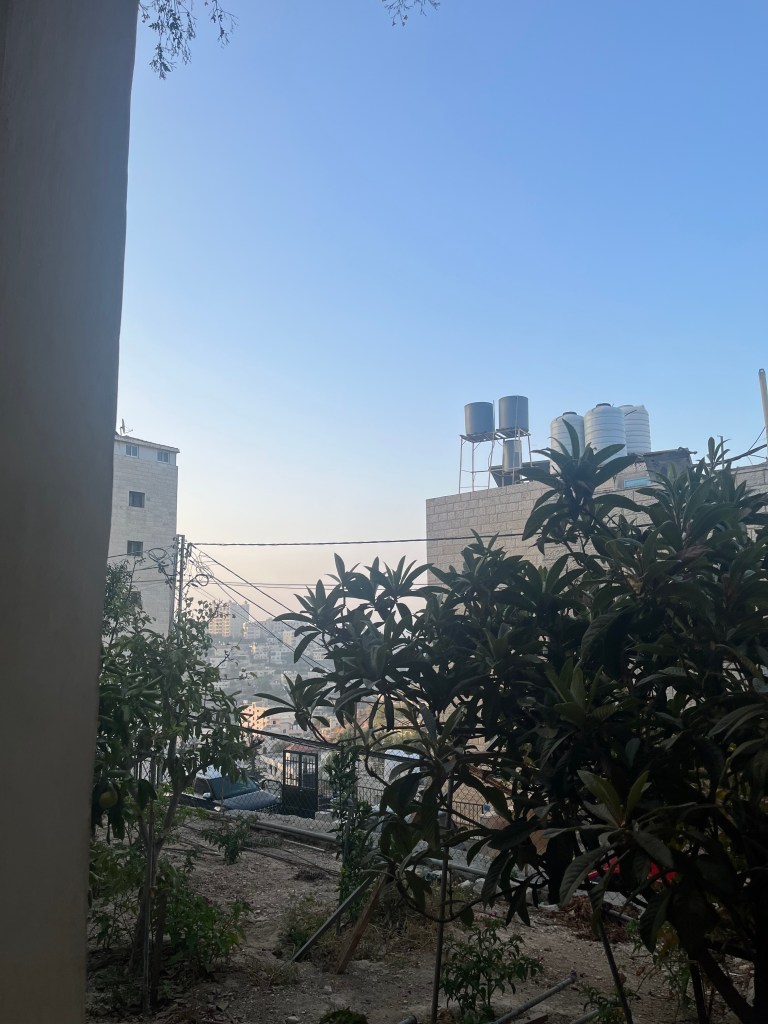
That night, their program director, Doug Magnuson, informed them of the new plan: they would return to Jordan first thing in the morning, taking part in a mass exodus out of Israel-Palestine as uncertainty about Hamas’ next moves grew along with a countdown toward an inevitable Israeli retaliation. The border crossing, which normally took about an hour and a half, was nearly six hours long.
“We weren’t sure at the beginning whether we were going to get back across to Jordan, because we weren’t sure if the checkpoints were open to get out of the West Bank,” said Magnuson. “And we weren’t sure if Allenby Bridge crossing would be open, but we told the students that if we couldn’t get out, we would be totally safe in Beit Sahour with our host families.”
As they said goodbye to their host families and returned to Amman, Kephart was mindful of how these people who had taken them in wouldn’t be able to flee the war.
“We got back to Jordan and in the coming weeks, we watched all the headlines come in and our hearts just broke for our host families,” said Kephart. “Just the fact that they were stuck.”
Since the war broke out, all of the program’s host families have stayed safe, with the fighting primarily concentrated in Gaza. Magnuson said that the hardest part of the war has been traveling – checkpoints and low visa acceptances have snarled, if not completely shut down, entire border crossings between Israel and Palestine. Kephart’s host family was immediately impacted by these security changes.
“My host sister is one of the few like Palestinians that is able to leave the West Bank with a special permit to work in Jerusalem,” said Kephart. “She was stuck in the city for multiple days and just had to sleep in a hospital bed because all the checkpoints were closed and no one could get in or out.”
When asked if they ever felt like they were in danger, all three students said no. They were quick to separate their experiences from Israelis and Palestinians who have lost so much in the war. The attacks did not happen in Bethlehem, they pointed out, and they quickly fled to Jordan, which is at peace.
“One of the difficult things was probably the perception that everyone in America had about what it was like,” said Henderson. “And all of us in Jordan, who were physically there, were like, ‘It’s fine here.’ There were some protests here and there, but it’s not dangerous. The fighting was contained, obviously, to Israel only.”
Safety remains a major concern for people and programs in Israel. The State Department is urging U.S. citizens to “reconsider travel” to Israel and many commercial flights have suspended their flights. After the conflict broke out, Wheaton canceled its spring Jerusalem semester program.
Although they were safe from any additional violence, there was no escaping the war’s effects in Jordan. The United Nations Relief and Works Agency for Palestine Refugees in the Near East (UNRWA) conservatively estimates that Jordan has taken in 2.2 million refugees since Israel’s 1948 founding. With so many Palestinians, Israel-Palestine relations are etched into Jordan’s national consciousness.
“After the war started, the atmosphere of Jordan changed and it just felt a lot heavier while we were there,” said Blackburn. “Everyone’s connected and everyone was feeling, and is still feeling, this great loss and hurt and hopelessness.”
In the Middle East, war and displacement are not unique to Israel-Palestine. Jordan is a melting pot of refugees from the Middle East and North Africa, home to hundreds of thousands of Syrian, Iraqi and Sudanese refugees in addition to Palestinians. At her internship with Marca Church serving refugees in Jordan (which has the second largest number of refugees per capita in the world), Blackburn was struck by the connections that refugees from across the region could make based on their displacement alone.
“They’re not directly connected to Palestine, but they still have all these feelings of loss of culture and country and experiencing violence,” said Blackburn. “They were all so heartbroken about it, even though they have so many other things going on with their own countries and being refugees in Jordan isn’t an easy thing. Their brokenness about the whole situation was really powerful.”
With such a strong connection to Palestine, Amman experienced daily protests for the first few weeks of the war. Many of these demonstrations have taken place by the U.S. embassy. The U.S. is often considered Israel’s closest ally, which draws the ire of many pro-Palestine protesters. To avoid any chance of dangerous encounters, students were advised to avoid the U.S. embassy for the rest of the semester.
Knowing the distrust that many people in Jordan had for the U.S., the students were careful to show their sorrow about the war. All three students learned how to say “I’m very upset about the conflict in Gaza” in Arabic. It was a surprise to Kephart, then, when Jordanians did not blame her for any errors they might have attributed to the U.S. government.
“In Jordan, people know the difference between Americans and the American government,” said Kephart. “I’m not hated by these Jordanians because I’m American. They may dislike my government, but they realize that I am not my government.”
Blackburn, Henderson and Kephart finished their semester abroad in early December. Other parts of their semester included visiting iconic sites like Petra and Wadi Mujib. For Henderson, however, his time in Bethlehem and its effects on the rest of the semester remains the most impactful part.
“People will sometimes say, ‘What was the highlight?’” he said. “And Oct. 7 is not a highlight because it’s terrible. But that’s one of the things that I’m going to remember the most.”
Correction: an earlier version of this piece said that the students’ Oct. 7 itinerary was canceled after the attacks began and that there have been daily protests since the beginning of the Israel-Hamas war. The Record regrets these errors.