
Once a week, for three and a half hours, 28 students meet in Blanchard 125 to discuss magic and fantasy. No – it isn’t some campus cult, devoted to casting spells or flying on broomsticks. It’s one of the newest Advanced Integrative Seminar (AIS) courses, a group of core classes that upperclassmen students must choose from at Wheaton College. This AIS, “Harry Potter: Theology and Literary Imagination,” is based around J. K. Rowling’s bestselling fantasy series.
Sarah Borden, professor of philosophy, and Kimberly Sasser, associate professor of English, work together to teach the course. The two first connected after Borden gave a virtual lecture during the pandemic called “How to Sin Like a Wizard,” where she related the Harry Potter series to virtue ethics, especially how it discussed original, personal and systemic sin.
Around the same time, Sasser invited Borden to speak about Harry Potter in her speculative fiction class where she was teaching on “Harry Potter and the Deathly Hallows,” the seventh and final book in the series. The two began to see the possibility of a full-scale class forming.
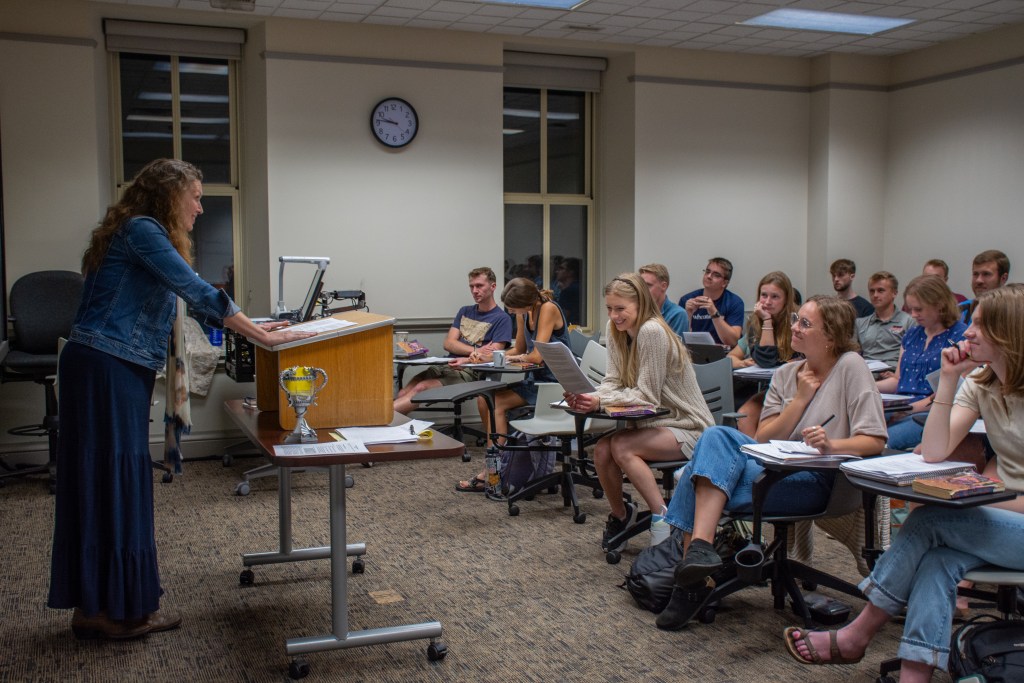
For the last two semesters, Borden and Sasser have been teaching the class in its current form. “Harry Potter: Theology and Literary Imagination” encourages students to theologically engage with the “Harry Potter” book series. One of its objectives is to track the theological progression of the whole series.
The series follows Harry Potter, an eleven-year-old boy who discovers that he is the child of wizards and pursues his birthright by attending Hogwarts where he learns magic. Each book tracks a school year of Harry’s life, with the themes and plot growing more nuanced and dark as he grows older.
In Borden’s office, the “Harry Potter” books were placed to the right of her desk, next to other works of philosophy. Stacked together, the series stands over a foot tall, showing how daunting the class’s task really is.
“We were committed to going through all seven novels in class because, if you’re going to try to read the series in relation to theology, you need the full scope of it,” said Borden. “But once you have all seven of those novels, you can’t add much else to the reading list.”
Borden also brought out three fully illustrated bestiaries, which are medieval compendiums of animals. She explained that evidence suggests that Rowling had access to and used these resources.
“A phoenix is a mythical creature, sure, but it is often associated with Christ and resurrection,” Borden said as an example. The series is wrought with traditional Christian and theological symbols, as well as mythological creatures, and appropriates them to the setting of the story.
“A 13-year-old can read Fluffy, Hagrid’s three-headed dog, as what it is just fine. But it’s also really interesting to see Fluffy as Cerberus, the guard of the underworld, and start to see what’s being said and how we think about it,” said Borden. “Part of why I think it’s worth spending time in the series is there’s more in it than it appears. It’s enjoyable on the surface, which is brilliant, but it also rewards the deeper, textual analysis.”

Outside of reading the books, the class is a combination of mini-lessons about the background world of Harry Potter and Harry Potter-themed small group activities, with each class reflecting on a different topic about the series.
This past week, the class discussed how the books were received by different communities throughout the series’ publishing history. Students in the class come from various backgrounds, some of whom grew up reading the series, while others are experiencing it for the first time.
Chris Whelan, a senior chemistry major, is looking forward to interacting with the series in a new way.
“I enjoyed reading ‘Harry Potter’ as a kid and it’s a fun work to revisit,” Whelan said. “I’m looking forward to taking a closer look at the series as a whole and considering some of the major themes in a biblical context, which often go unnoticed by casual readers.”
The theological connection the students draw in the class culminates in a research paper they will develop over the semester.
“We let students do the theological work on their projects and let them figure out what the connection means for themselves,” said Sasser. “We don’t prescribe a model, and we say, ‘You have to get into the project and figure it out.’”
“And that’s part of the fun of it, right?” Sasser posed.
Addy Hyatt, a senior business and economics major, says the class seems eager to explore the wizarding world.
“I can already tell there are a lot of Potterheads in the class who have a lot of knowledge of the books and are excited to dig deeper,” said Hyatt. “Getting to see a new perspective brings a fresh and new way of seeing the series.”
In the classroom, on the first day of class, Sasser and Borden made cupcakes that had different colors inside. Students who were unfamiliar with the series were given mystery cupcakes that acted as the “Sorting Hat,” the magical entity that separates Hogwarts students into their respective houses.
More serious fans of the series were allowed to sort themselves based on their personality. It is all part of the effort to encourage students to really enter into the magical world the series presents, beyond just reading the books.
Sasser emphasized the idea of applying “the Christian imagination” as she and Borden lead the class in theological discussion and literary analysis of the text.
“Literature communicates in a particular way, and I think it does so in a way that fits with how we view our tradition, how we think about the Bible and how it works,” said Sasser. “God has chosen to communicate with us through poetry, narrative and all these different genres, and it’s up to the reader to collaborate and determine meaning.”
“It’s not just this passive reception of all the rules and ideas we have to engage,” said Borden. “We have to engage our imagination, our thinking and our analysis and our bodies.”
