
Growing up on the Hopi reservation in Arizona, Noelle Hutchcraft, a junior psychology major said her mom often surprised her by pointing out plants that can be used to make soap, to heal cuts or simply to eat.
“We’re very crafty people,” said Noelle Hutchcraft, who is Navajo, saying she appreciates the ingenuity and perseverance she learned growing up.
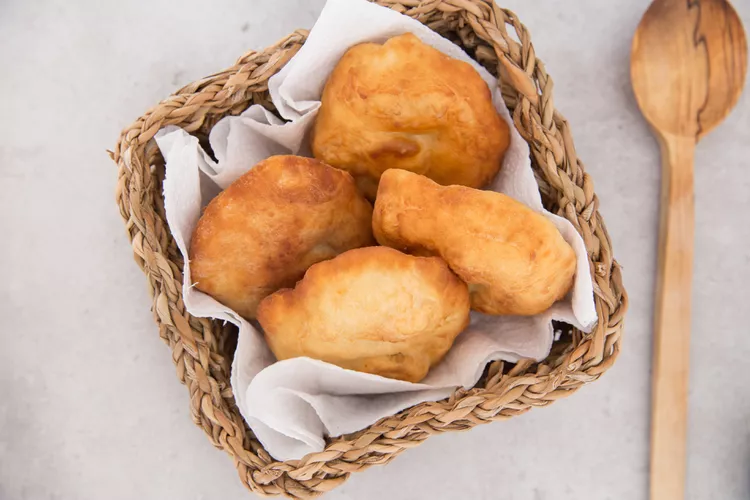
Hutchcraft said fry bread is another reflection of the ingenuity of the Navajo people (who call themselves the Diné). Fry bread originated in the mid-19th century when the Navajo were forcibly removed from their lands and relocated to reservations. It consists of flour, salt, baking soda and oil, some of the few ingredients that were available to them and enabled them to survive.
While some Native Americans reject fry bread as a legacy of colonialism, others see it as a symbol of the resilience of indigenous people. “A very strong narrative of most of Native America is one of persevering through hardship and making do with what you have and making it into something special like fry bread,” explained Hutchraft.
Hutchcraft said she is the only student she knows of who has a Certificate of Degree of Indian Blood (CDIB) and grew up on a reservation. The Bureau of Indian Affairs issues CDIBs to individuals who can prove a certain percentage of “Indian blood,” or blood quantum, from a particular tribe. A CDIB is a federal document and is not equivalent to tribal membership, which is determined by each individual tribe. The blood quantum requirement can be controversial because it inherently excludes certain people while including others, with complex social and political implications.
Hutchcraft grew up in northeastern Arizona on the Hopi reservation, which is separate from but located within the Navajo Nation reservation. Her mother is Navajo and her father is white, though part of his heritage is Choctaw Native American.
Hutchcraft said she does not identify more with one side of her family than the other because of how well her parents integrated both cultures into their household. “Even if we weren’t living on the reservation, it wasn’t really a question in my mind whether or not I was Native. It was more of an assumption,” she said. “That was life. That was just how I grew up.”
Although being at Wheaton has not always been easy, Hutchcraft said she is used to adapting to the culture around her because of how much her family moved around during her childhood. “I’ve been in schools where it was all Native kids and I’ve been in schools where it’s primarily caucasian, so it isn’t something new to me,” she said.
Because of her mixed heritage, many people do not immediately know that Hutchcraft is Navajo. “Most people assume I’m Latina when they look at me,” she said.
Although they may not know much about Native American culture, Hutchcraft said people at Wheaton are generally very curious. “They might be a little awkward or quiet when the topic does come up because there’s just not a lot of knowledge. But, for the most part, people are pretty curious and generally respectful,” she said.
However, she does not go out of her way to tell people that she is Native American. “I don’t want it to become an identifier,” she said. “I think it can be dangerous to label because I don’t want to be the only voice on campus. I can’t speak for all Natives. I can’t speak for every tribe. There are so many tribes in the States that are so different from one another.”
One thing she does try to advocate for is a better representation of Native Americans in the media. “Some people might not be able to tell that I’m Native because in their mind a Native is what that mascot is, or a Native is this person in a really long headdress with paint over their face.”
Despite these stereotypes, Hutchcraft hopes that people can learn that Native Americans “come in all different skin tones and that every tribe is going to look different from one another.”
Being a Christian as a Native American also presents unique challenges. Hutchcraft said before she became a Christian, she had a negative perception of Christianity and what she believed to be “the white man’s God.” Now, however, she and her family follow the principle of “showing, not telling” as they share their faith with Native Americans. “We try to show our ideals as Christians and always be willing to sacrifice or be generous in any way we can, just showing rather than telling.”
In the past, when Hutchcraft worked with Native youth, she said they’ve been more receptive to Christianity after she explained to them who Jesus really was. “I’m pretty sure Jesus was much darker than I was, he came from a rural area, and he had a tribal name. He came from the tribe of Judah. When you actually start looking into who Jesus was as a person, it’s closer to what I think I grew up with than people realize,” Hutchcraft explained.
Melissa Harkrider, associate professor of history, also affirmed the complexities of being a Christian as a Native American Christian. Harkrider’s husband and son are part of the Cherokee Nation, and she has researched and taught extensively on Native American history.
She said she remembers some colleagues of hers being uncomfortable listening to a Native American Christian play a traditional drum and pray in their language. “When Native Americans use musical instruments that are associated with their culture, or even pray in their native language, there’s still some suspicion as to whether Natives can really be Christian,” she said. She expressed her desire to see more Native American speakers and church leaders invited to speak on campus to foster better understanding.
Every year, the month of November is set aside to honor the culture and contributions of American Indians, Alaska Natives, and Native Hawaiians in the United States. But because there are so few Native American students at Wheaton, it can be difficult to facilitate events, explained Hutchcraft.
When it comes to raising awareness about Native American culture and history at Wheaton, Hutchcraft said, “I feel like it’s more realistic to keep it on a one-on-one level until there are more students on campus.”
Harkrider pointed to various factors for why there are so few Native American students on campus. “Native Americans have the lowest number of students who graduate from high school of all racial groups,” she said, and there is a lot of mistrust of educational institutions as a result of the boarding school era. Another factor is the financial hardship of attending university for first-generation college students.
Given the low number of Native students on campus and the difficulty of organizing larger cultural events, Hutchcraft stressed the importance of one-on-one interactions. “Don’t be afraid to ask questions,” she emphasized. “Especially if the person seems willing to share, do not be afraid to ask questions, because that’s the only way that people will actually learn and the only way that these stereotypes can be broken.”
