
At 3:30 p.m. every Thursday, a group of uniformed cadets gather on the front lawn of Jenks Hall for a long afternoon of Reserve Officers’ Training Corps (ROTC) training. After the fifteen-minute drive to Blackwell Forest Preserve, the cadets perform tactical labs, learning skills such as first aid, radio operation and weapon assembly and disassembly.
They may also practice a mission, such as an ambush. With a short break for dinner, they gather again in Meyer Science Center until 9 p.m. for their weekly military science class.
But for Jacob Snell, a senior international relations major, ROTC training is just the tail end of an even longer day. Snell is on the cross country and track teams and has daily practices in addition to his weekly ROTC commitment. Athletes whose practice conflicts with the 3:30 p.m. lab on Thursdays, called Leadership Lab, are exempted from it.
On Thursdays, however, the cross country runners practice independently, so Snell is responsible for fitting in a run before he goes to lab and class in the evening — in addition to attending his other classes and completing schoolwork.
According to Lieutenant Colonel Alex Moen, professor of military science, of the 63 Army ROTC cadets at Wheaton, 14 are also student-athletes. Football players make up the largest number of ROTC athletes, with a smaller number of cadets on the soccer, cross country, track and field, wrestling, swimming, basketball and golf teams.
Some students have signed a contract to serve in the Army after college. Of those who are required to serve after graduation, some have accepted a nationally-awarded ROTC scholarship or a campus-based scholarship, while others have signed a non-scholarship contract. Freshmen and sophomores are permitted to participate in ROTC without signing a contract, and some have not yet decided if they will pursue a career in the Army post-college.

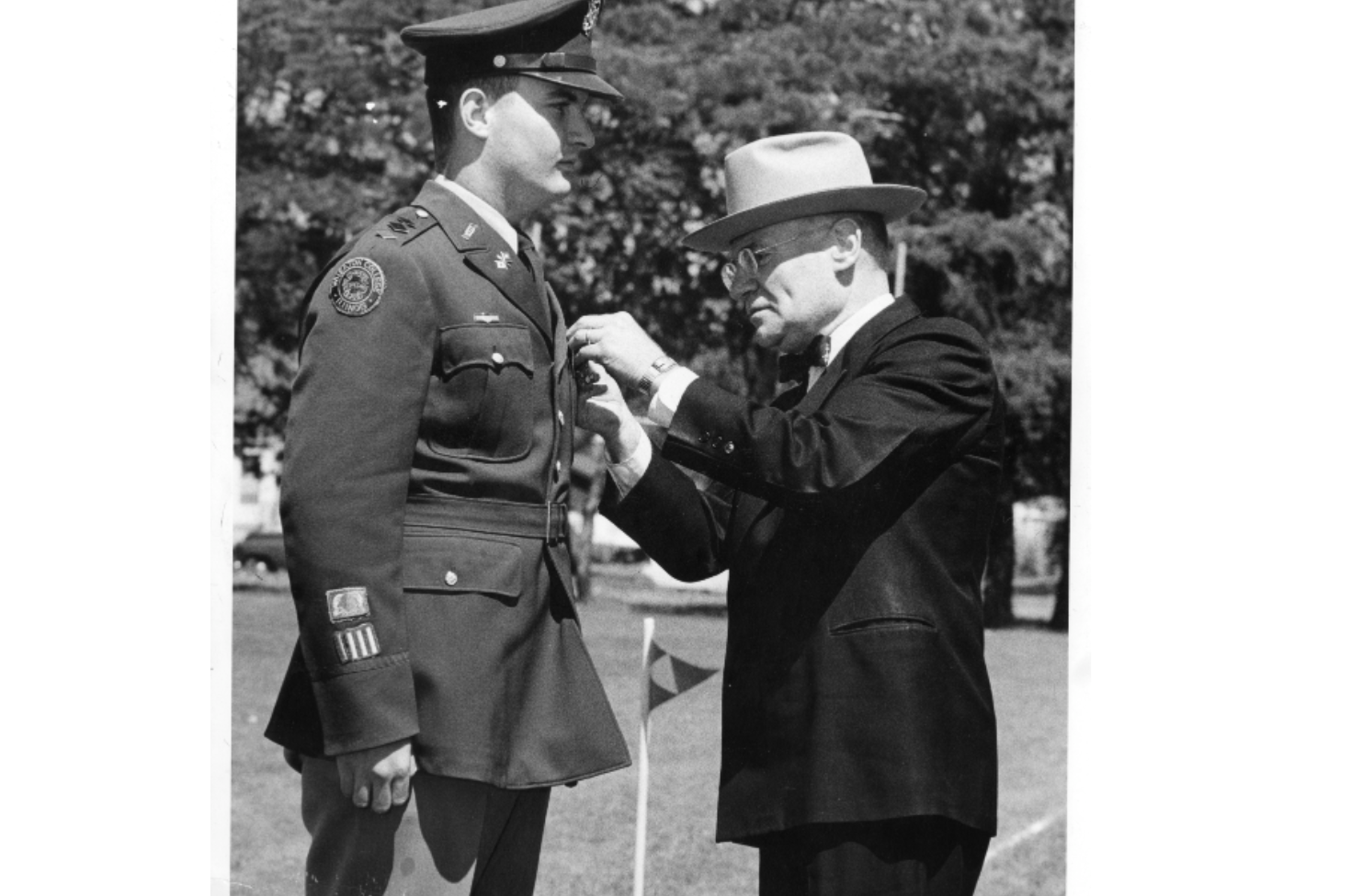
Photo from the Wheaton College Archives Photograph Collection.
Established in 1952, Wheaton’s Army ROTC Rolling Thunder Battalion is one of the largest ROTC programs in the Midwest, second only to the University of Minnesota. It includes Wheaton students and students from eight other neighboring universities, called crosstown schools, for a total of 190 students program-wide.
Crosstown agreements allow cadets at schools without an ROTC program to participate in a nearby school’s ROTC program.
In addition to their regular schoolwork, the weekly Leadership Lab and military science class, cadets also participate in physical training (PT) every Monday, Wednesday and Friday from 6:00 to 7:15 a.m. Once per semester, cadets complete a weekend field training exercise (FTX).
Elizabeth LaBrin, a junior health science major, is on the cross country and track teams, making her one of three women in ROTC who participates in athletics. She explained that her long-distance training helps her perform well on the running portion of the Army Cadet Fitness Test (ACFT). Cadets take the fitness test twice per semester, and it includes six events: deadlift, standing power throw, hand-release push-ups, sprint-drag-carry, plank and a two-mile run.
LaBrin said she supplements her running with weight training to perform well on the ACFT.
“That’s another thing that you have to be self-disciplined in,” she said. “After my two-hour run that I just did, now I’m going to have to go lift for like another hour.”
Clara Rudolph, a junior history and international relations double major, participates in ROTC, cross country and track and field. She joined the cross country team at the beginning of this school year. “I almost joined freshman year, and then didn’t because I was worried it would be too hard to do both,” she said.
“I’ve found it to be pretty easy and doable,” Rudolph said, explaining that getting a firm grip on ROTC before joining cross country may have made it easier for her to do both. “I do think that if I had done both freshman year, I would have been more overwhelmed.”
Rudolph and LaBrin work together to stay in shape for running and ROTC. Because there is less emphasis on strength training in cross country than in other sports, Rudolph and LaBrin have to put in extra effort to meet the strength requirements for ROTC.
“We definitely have to plan and make sure we’re still lifting. You have to take it upon yourself to do that,” Rudolph said.
David Huber, a sophomore philosophy major, is an ROTC cadet who plays on the men’s soccer team. For Huber, balancing ROTC and soccer has been doable. “The cadre, or the professors, recognize that you’re learning some of the same skills that are applicable to military life in athletics,” he said. “You have to be wise in managing your time, but it’s not terrible.”
Another ROTC cadet, Aidan Laird, said the skills he has cultivated in ROTC and athletics are mutually reinforcing. “ROTC is a lot about leadership development,” said Laird, a sophomore history major on the wrestling team. “It’s really helped me develop as a leader within my team.” He said wrestling also helps physically prepare him for ROTC.
Snell is a captain of the cross country and track teams at Wheaton. Having grown up in a military family, Snell said he appreciated the development opportunities that he had seen in the army, as well as the benefits of his scholarship.
As with all ROTC athletes, when Snell is in season, he is exempt from ROTC’s morning PT sessions and Thursday Leadership Labs. This allows him to focus his training on running.
Because of the PT exemption for ROTC athletes, Snell said it has not been too difficult to balance the physical demands of both commitments. He does, however, feel a tension between the cultures of both groups. “I didn’t expect both of them to have such strong cultures,” he said. “I didn’t expect that having leaned into the culture of the team so much that it would make it challenging to fully lean into the ROTC culture as well.”
The captains of the cross country team work hard to integrate faith with running, Snell said. “The most important thing we’re doing is not winning races. It’s not even running our new PRs . It’s that we do it to the best of our ability in a way that glorifies God,” he said.
Military culture, however, can be different, Snell explained.
“As someone who grew up in the Army, I felt the culture of the Army,” he said. “There’s a drive for success and for a level of competition, and sometimes it can go to an unhealthy level of trying to sacrifice a lot of things in order to be the best.”
Snell said that though this is not necessarily representative of the Rolling Thunder Battalion at Wheaton, his experience with military culture growing up made him lean more into the culture of the cross country and track teams during college.
Laird, like Snell, feels closer with members of his team than with fellow cadets. “I’m definitely closer with the wrestling team than I am with the ROTC people, but that’s just because of the fact that I spend more time with them,” he explained.
Huber, on the other hand, emphasized some of the similarities in culture between ROTC and athletics. “You’re showing up. Excellence is expected. You’re working hard. You’re trying to love and care for one another. You’re trying to lead well in both environments. I think some of those things are pretty core and consistent,” he said.
Within the ROTC community, the subset of cadets who are also athletes tend to help each other out. If an athlete misses an ROTC event because of a sport-related conflict, Snell said he’s more likely to text another ROTC athlete for help because they understand the tension of both commitments.
Although at times running gets more of his attention than ROTC while he is in season, Snell looks forward to his future leadership roles in the army. “I would love to take the things I’ve learned from running and from my time at Wheaton as a whole — how I’ve seen people lead and the things that I have learned at ROTC — and apply those to be a leader in the army,” he said.

