
The President’s Ball, known on campus as “Prez Ball,” is an annual tradition Wheaton College students anticipate attending, to dance away the stress of classes, sports and responsibilities. Yet the consistency and popularity of this event for the past several years is founded upon a long, fragmented history that dates back to 1909 — when the first “Prez Ball” occurred.
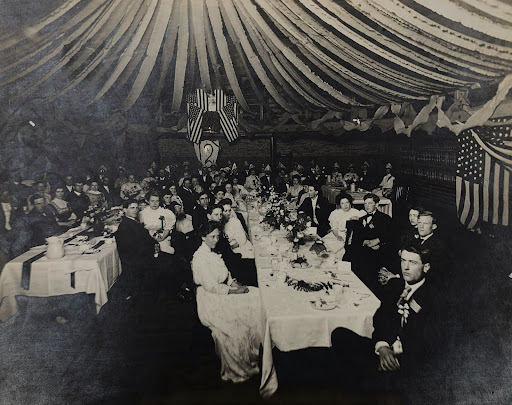
On Feb. 12, 1909, a dance took place in the Wheaton College gymnasium, now Adams Hall, to celebrate Abraham Lincoln’s birthday. The inaugural dance was originally meant to be on George Washington’s birthday, but due to that year being Lincoln’s centennial celebration it was changed to celebrate the Illinois native instead.
However, in the years to come, it would morph into a tradition commemorating Washington, named the Washington Banquet (WB).
The general practices of the WB stand in stark contrast to how Prez Ball is celebrated now. Unlike today’s dance, it was not common to bring a date but to sit by class sections at elegantly decorated tables. There was also no dancing. Students were encouraged to “dress their gaudiest” and listen to their classmates give speeches, toasts and lead chants, as described in a 1940 issue of the Record.
What does remain the same is the class rivalry. A long-standing tradition was that the speaker of each class remained anonymous until the day of the banquet so that the class speakers would not “mysteriously disappear.” Although the student speeches were not formally a contest, they were treated as such, with the threat of having one’s class speaker being “kidnapped” by the other rival class prevalent. The 1939 Record issue explains how “it was dangerous, however, to announce the names of the speakers of the affair, lest they be kidnapped, taken into the country, and left to walk back.”
Also continuing for a long time, until 1914, was the practice of “yells.” Each class would try to “out-yell” the other through chants and mockeries until a clear winner prevailed. These cheers were characterized as “lusty cheers started the friendly competition of class yells,” per the 1927 issue of the Record.
These yells, most prominently seen in 1914, ranged from “It’s purple, it’s purple, it’s purple and white; sophomores, sophomores, they’re alright” to “every little freshman has a movement all his own, by his awkward clumsy actions can his class be known.”
Apart from the chants and yells, the banquet had live music, often featuring the men’s and women’s Glee Clubs.

From 1909 to 1937, the Washington Banquet was held in the Coray gymnasium, until 1938, when the banquet was moved to the Stevens Hotel in Chicago. From then on, hosting the WB at a hotel or venue in the Chicago area was a consistent procedure. The 1939 Record issue states “The affair has now been moved to Chicago to accommodate the large attendance,” the Record reported in 1939. “Yet traditions remain the guide for all banquet preparations.”
1939 was also pivotal because the WB eliminated the class yells and student orators. Instead, it was treated with a more formal atmosphere, where honored guests like state congressmen, pastors and professors would come to speak at the event. In 1955, Billy Graham attended the banquet held at Palmer House, speaking about American society’s problems and how to best prepare for that period’s anticipated crises.
Another interesting tradition sprang up in 1945 where a couple, in order to embody the spirit of Washington’s patriotism, was chosen to be “George and Martha Washington.” The couple would attend the banquet dressed as George Washington and the First Lady and give a short speech amid the other activities.
Although the event was formal in its elegance and grandeur, students had fun through “co-ed” dates. In 1950, two students, junior Bob St. Pierre, and sophomore John Jundt, were featured on the cover of the Kodon Literary Magazine because of the prank they played. The prank featured Pierre being escorted by Jundt to the banquet, who was dressed in the full attire of a woman.
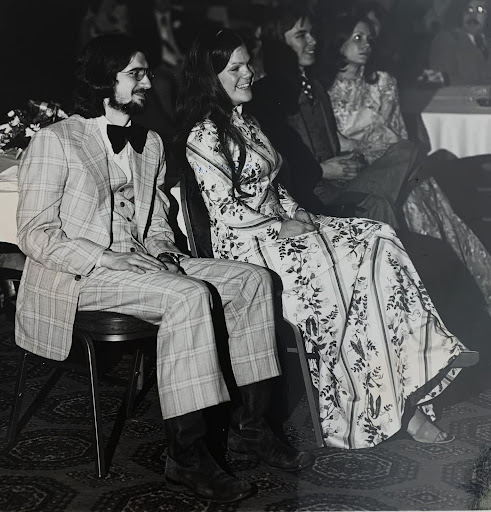
Yet in the late 80s and 90s, the consistency of the Washington Banquet slowed to an irregular occurrence until it stopped altogether, only coming back for an appearance as a “February Formal” in 1994. From that time on, the February Formal was a graceful event with dinner, speakers and entertainment.
In 2004, the Community Covenant was altered and allowed dancing after a 143-year ban, leading to the first Prez Ball with dancing to take place in the Eckert Gym. Steve Ivester, the dean for student engagement, recounts how this ball took place.
“It was a big deal that we were now allowing dancing and that we were doing a ballroom dance, but it was all structured,” Ivester said. “So everything about it was organized and classy, and there was no free dancing.”
The Prez Ball of 2010 was simultaneously used as Wheaton College’s sesquicentennial celebration. After that night’s guided dance and activities had ended, about 150 students gathered in Lower Beamer to free dance to their own music. This led to a year-long process of creating further change to the dance policy, ultimately ending in what is now upheld today.
Ivester clarifies how the shift of past balls that used to focus on Washington has now taken on a dualistic meaning ever since 2010, highlighting both the holiday and President Ryken. “It is an honor of the president of the college, not George Washington,” Ivester said. “They wanted the first ball to be Dr. Ryken’s ball. And then a couple of years later, we moved it to Monday because of the convenience of a holiday.”
The Record shows that amid these significant changes, the same desire to gather as a school and celebrate together remains the same throughout these past 116 years.

