
In mid-February, Wheaton, like other colleges and universities around the country, received new guidance from the Department of Education on how to deal with matters of race and diversity. That guidance, known as a “Dear Colleague” letter, claimed that DEI programs — which stands for diversity, equity and inclusion — are discriminatory and should be banned.
In particular, the letter applied a recent court ruling banning schools from considering race in admissions to almost all college programs: “admissions, hiring, promotion, compensation, financial aid, scholarships, prizes, administrative support, discipline, housing, graduation ceremonies and all other aspects of student, academic and campus life,” according to the letter. Schools that violate this guidance would risk losing federal funds.
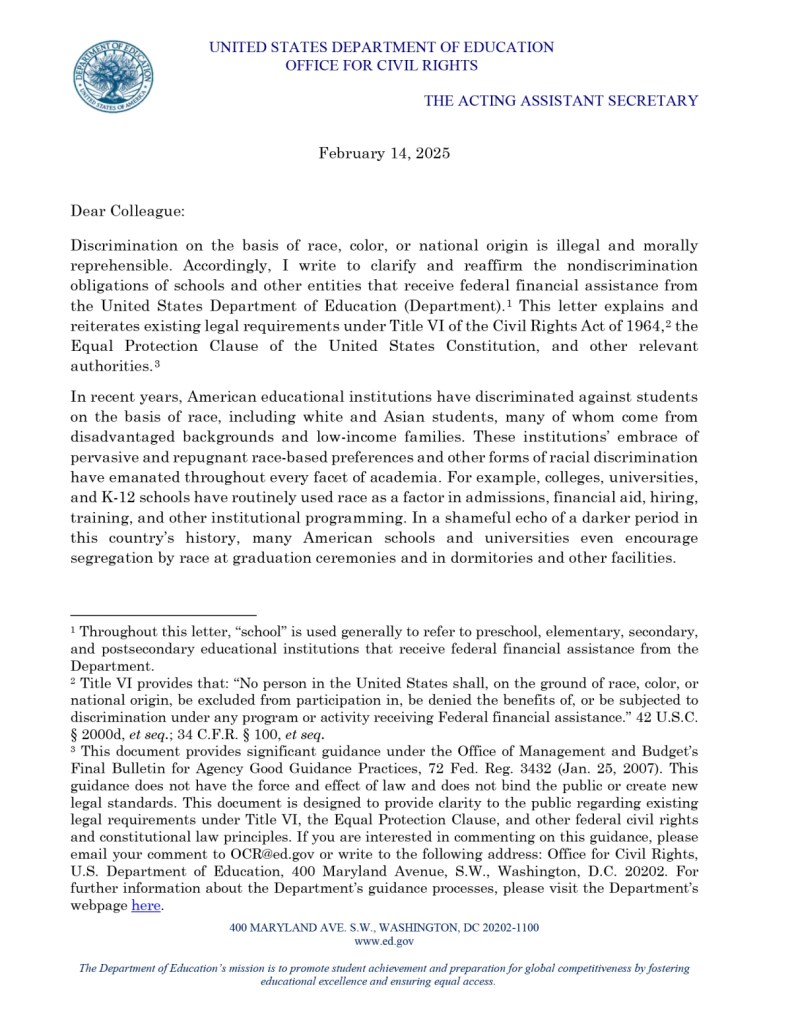
The “Dear Colleague” letter, sent on Feb. 14, cited the Supreme Court’s 2023 decision on Students for Fair Admissions v. Harvard to say that race can not be considered by colleges during admissions, hiring, financial aid, scholarship determinations, etc. The letter claims that American educational institutions have been discriminating against White and Asian students coming from disadvantaged or low-income families.
Leaders at Wheaton say that while they will adhere to federal law, the college still believes in the kind of “kingdom diversity” found in the Bible.
In response, on Feb. 24, Wheaton College President Phillip Ryken affirmed the institution’s commitment to “kingdom diversity” — the belief that “commitment to diversity, inclusion, justice and unity is central to fulfilling the great commission, the greatest commandments and Wheaton’s College mission.”
Wheaton College expresses its vision of kingdom diversity as follows: “To enable our Christ-centered campus in our commitment to respect and love one another, to engage inter-culturally, to uplift the disadvantaged, to live in community, from every nation for his glory.”
Silvio Vazquez, chief enrollment management officer, said that he would distinguish the federal ban of DEI as separate from what kingdom diversity stands for — biblically-based values. He clarified that the admissions process has not included race data when reading students’ applications for enrollment since the initial Supreme Court ruling against affirmative action, and DEI bans do not affect recruitment or the mission of the office of admissions.
“Kingdom diversity” is not limited to race or ethnicity, but “has everything to do with where the church is not represented here,” Vazquez said in an interview.
Since the “Dear Colleague” letter was published, relevant Wheaton offices have conducted a large-scale review of the website to ensure that all language regarding kingdom diversity is explicitly welcoming to all students, as it has always been in practice, according to David Cho, director of the Office of Multicultural Development.
Beyond these wording clarifications on kingdom diversity, there have not been changes to policy, practice or procedure since the “Dear Colleague” letter, as Wheaton’s institutional commitments are seen as both “magnifying compliance” and protected by religious freedom, said Cho.
The demographic breakdown of students currently enrolled at Wheaton is about 69 percent white, 10 percent Asian American, 7 percent Hispanic, 6 percent multi-ethnic, 3 percent international and 2 percent Black students, according to College Factual, which compares and ranks colleges in many categories.
Following Ryken’s affirmations, many students were still worried about scholarship cuts, the disbanding of student groups and that multicultural events would cease, which is happening at other, secular universities. The specific requirements for how changes may be made were not explicitly stated by the Office of Civil Rights, but institutions were given a two-week period to comply. The consequence of not removing diversity initiatives was losing federal funding.
None of the college’s grants or scholarships were reportedly affected by the “Dear Colleague” letter, including the Office of Multicultural Development’s Summit Multicultural Scholarship, which supports fifteen students who demonstrate commitment to kingdom diversity each year. This scholarship has been open to all prospective students since it was consolidated in 2019 from several other previous multicultural scholarships.
Cho said that there are no scholarships existing specifically for only one racial or ethnic background to be in jeopardy. However, if federal funding were to be taken away from the college, Pell Grants would also be at risk, which would affect students in federal work-study programs.
Cho said that, in his conversation with students, the ambiguity about how policy changes have played out has contributed to a sense of “heaviness” and “fatigue.” Beyond that, rhetoric that says that the Civil Rights Movement “exclusivist practices are segregationist” has been a painful retelling of the history to live through.
“And yet as a Christian, your freedom is in Christ,” Cho counsels his students. “How do you access that freedom and joy when there’s a mix of emotions going on?”
Student body President Marina Ntragatakis believes in Wheaton’s ability to handle matters in a manner consistent with its institutional foundation and holds hope for what kingdom diversity represents.
“We are highly confident that Wheaton College’s administration is committed to a Christ-centered approach to diversity that ensures current and future generations of Wheaties can fully benefit from a community reflective of the kingdom diversity that we look forward to, with great expectation, in the Kingdom to come,” she said.


