
By Kara Grace Hess, Features Editor
Waking up to news of the death of Pope Francis on the phone, Mack Ibrahim was in disbelief along with much of the rest of the world. But that was not the only feeling that lingered — since then, solidified by a constant flurry of social media coverage, the news of Francis’ passing has prompted a mix of grief and gratitude for Ibrahim.
A senior studying English writing, Ibrahim is grateful for the care Francis demonstrated towards the Catholic church in Gaza. He called the Catholic church in Gaza every night since the start of the conflict. Ibrahim hopes to see the next pope continue the momentum Francis created through further support for developing nations.
On Thursday, May 8 Cardinal Robert Prevost was elected the first American Pope, choosing the papal name of Pope Leo XIV. The vote was a two-thirds majority with 133 cardinal votes in his favor. He is a Chicago native, but has done missions work in South America and in Trujillo, Peru where he worked 2014-2023.
CNN’s Vatican analyst, Elise Allen, reported that “He’s somebody that, even though he’s from the West, would be very attentive to the needs of a global church.”
Francis died at 88 years old while recovering from double pneumonia after suffering a heart attack and a stroke.
Madi Emmitt, a sophomore studying chemistry and Chinese, has been a Catholic since she first heard about the Christian faith from her grandma in middle school. Coming to Wheaton has incited her to appreciate the structure of the Catholic church, and like Ibrahim, she has been reflecting on the legacy of the pope.
Emmitt appreciated how the Pope was radical in the ways that he cared for the marginalized. She described him as an inspiration for modeling well what it looks like to live like Jesus.
At the April 21 campus chapel, Emmitt felt included with the prayer Francis had prayed during his papacy, which was echoed in the prayer of Greg Anderson, for hearts to be made “more like Jesus.” The adjunct education instructor’s comments before, expressing shared grief with “our Catholic brothers and sisters,” paid necessary homage to the life of Francis for Emmitt.
“He challenged Christians and specifically Catholics to reach out to those who are marginalized: LGBTQ+ people, people of color, people who have not been represented or welcomed or loved well by the church,” she said. That was very radical.”
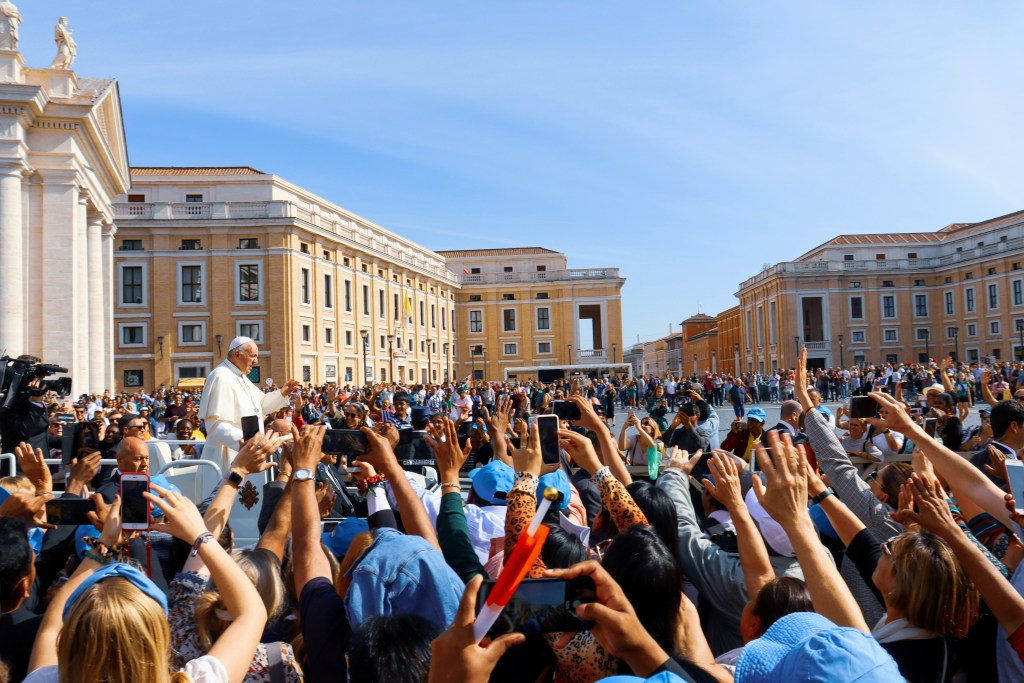
Francis was also known for advocating for migrants and refugees, in January calling President Trump’s plans to deport migrants a “disgrace.” In 2016, before Trump won the presidency, the pope was reported to have said of Trump, “A person who thinks only about building walls… and not of building bridges, is not Christian.”
During his papacy, Francis installed the first Black cardinal in Washington, D.C., Wilton Gregory. The other two Black cardinals, Pete Turkson and Robert Sarah, were appointed by Pope John Paul II and Pope Benedict XVI, respectively. In addition to that, Francis wrote letters to bishops and issued several declarations with condemnation for the “sin” of racism, another element of what contributed to his reputation as an advocate.
As bishop of Rome, the pope is the head of the Catholic Church, where he appoints and oversees the bishops of the Catholic Church. He is advised by cardinals, who act similarly to bishops with other responsibilities in the larger Church.
Emmitt said she has always thought submission to the Church made sense, which made the death of Pope Francis all the more impactful. However, she attributed a culture of individualism to preventing greater mourning in United States Protestantism.
“The ‘my salvation, my theology, my interpretation of Scripture,’ everybody’s their own pope,” she said while recounting the gravity of this event for the larger Catholic Church in contrast to many Protestants.
Emmitt isn’t the only Catholic at Wheaton to remark upon the radicalism of Francis. Eric Rumsey came to Wheaton in 2019, and although now he is on a break from his studies, he is majoring in music with elective studies in philosophy. He decided to convert during his time at Wheaton. After becoming curious about orthodoxy and Catholicism, he researched and had many conversations with a Catholic friend. During his research process, he described confronting and deconstructing his initial beliefs that Catholic doctrine was less Christian.
Through the process of pursuing more information on Catholicism, the summer after his sophomore year, he tried to convince himself out of converting. Ultimately, though, like Emmitt, it was the emphasis on the authority of the church and the pope that stuck out. For Rumsey, this was a large factor in his final decision to convert.
Also like Emmitt, he admired the courage that Francis had to accept criticism from both sides of the political aisle.
“He’s not afraid to boldly say stuff that his community isn’t going to be a fan of,” he said. “Pope Francis was not so much concerned about seeking the accolades of any particular community, as he was about being willing to take the genuinely honest path.”
The Catholic Church is structured with the Pope in the highest position, then cardinals, archbishops, priests, deacons and then the laity, otherwise known as the people of the church.
Rumsey was astounded by the tributes to his death, some even coming from people who had criticized him during his life, such as Catholic anthropologist Trent Horn. He also valued the simplicity of how Francis lived, often foregoing fancier vestments and even giving up the privilege of having a summer house to “show care to those struggling and suffering,” he said.
Renata Marantz, a sophomore studying business and economics, recalled her memories of how people talked of Pope Francis with reverence while she attended a Catholic high school in Hawaii. The images that were shown of him visiting schools or baptisms are prominent in her mind, characterizing the pope as a “great person.”
“I loved how all the sisters would talk about him whenever they came to the school,” she recalled of their visits.
Emmitt challenged Wheaton Protestant students to take this moment of change within the Catholic Church to learn more about the Catholic Church. Many of her peers have been asking her what the selection of a new pope looks like. She desires to see students seek out answers for themselves, too.
“It’s just a good reminder that a Christian is anyone who confesses that Jesus Christ is Lord,” she said.
Emily McGowin, associate professor of bible and theology and an Anglican priest at Christ Our Advocate, stresses the responsibility of Protestant Christians in this moment.
“There’s a big difference between recognizing the pope as the authoritative head of the church and recognizing his profound influence as a Christian leader on the world stage,” she said. “Protestants can’t do the former, but we certainly can and should do the latter.”

