
By Claire Taylor, Staff Writer
On Oct. 10, Wheaton Archives and Special Collections hosted an event honoring Samuel Escobar, a Peruvian theologian and writer, and celebrated the installation of the Escobar Papers in the Evangelism and Missions Archive.
Samuel Escobar was a prominent pastor and theologian who emphasized that justice and evangelism are inseparable. He was often found debating Marxist college students in Latin America and presenting Christianity as an alternative. He proclaimed that true Christianity should fight against oppression, and the hope of justice was found only through Christ.
Escobar played a major role in the first Lausanne Conference in 1974, speaking on the integration of faith and justice. He is arguably best known for his books “The New Global Mission: The Gospel from Everywhere to Everyone” and “In Search of Christ in Latin America: From Colonial Image to Liberating Savior.”
He died April 29, 2025, in Valencia, Spain.
Escobar visited Wheaton College many times, including speaking at chapel in 2015. Archivists Bob Schuster and Paul Ericksen identified the academic and theological value of the Escobar Papers and began discussing bringing them to Wheaton with Escobar more than 20 years ago. That effort came to fruition this summer.
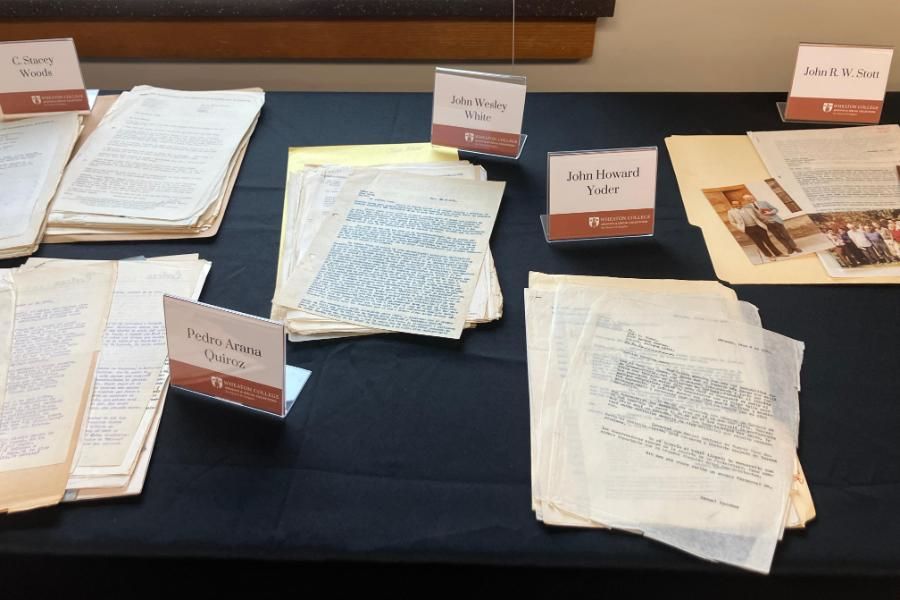
The papers document Escobar’s involvement in the 1974 Lausanne Conference, including his annotated copy of “A Vision Pursued: The Lausanne Movement, 1974-1986.” The collection also includes original letters both to and from Escobar, along with other writings, photographs and personal items.
Escobar’s son, Alejandro, spoke at the event, reflecting on the process of gathering his father’s papers and sharing remarks from his sister, Lily, who was unable to attend. “My dad was very action-oriented,” he said. “He was a networker by nature.”
J. Daniel Salinas of the Biblical Seminary of Colombia spoke next, remembering Escobar as a “walking encyclopedia.” Salinas would often email Escobar asking academic questions or looking for research resources.
Remarks from Ruth Padilla DeBorst were prerecorded and played at the event. She first met Escobar as a child, as he was a close friend of her father, Ecuadorian theologian René Padilla.
“I could not thank God more for Samuel — Samuel the uncle, Samuel the friend, Samuel the scholar, Samuel the colleague,” Padilla said.

Canales, who requested to share his remarks in Spanish in honor of Hispanic Heritage Month and because Escobar was “a prominent Hispanic scholar,” spoke next. Litfin Divinity School student Andrew Panaggio translated his message.
“I am a patriot of Samuel and a fruit of Samuel’s ministry,” Canales said. “Thank you for the legacy that you left for our generation. And you can feel satisfied and content that you planted a good seed.”
Daniel Carroll then shared photos and stories of his time with Escobar in Spain, where he collected items for the archive. Carroll spent more than eight hours a day for several days gathering and packing Escobar’s writings.
The final remarks came from President Philip Ryken, who quoted Hebrews 11:4 in reference to Escobar.
“‘Even though he is dead, he is still speaking.’ There’s a living legacy that breathes through the papers, materials and artifacts that we have in special collections. And this is a wonderful way for Samuel Escobar’s voice to continue to be heard,” Ryken said.
Scott concluded the event by presenting the “Journal of Latin American Theology, Vol. 20,” in Escobar’s honor.
“I urge you to read the journal. I urge you to admire and learn from the legacy of Samuel Escobar. But more importantly, or most importantly, may you grasp his spirit to love God more fully and to serve our neighbors more deeply,” Scott said.
The event concluded with an invitation to visit the archives and view the Escobar papers. A display featured several items from the collection, including books from Escobar’s personal library, documents about his interest in Christology from a Latin American perspective and photographs capturing significant moments in Escobar’s life.

