By Cade Acker, Staff Writer
In an email sent out by the Wheaton College President’s Office to returning students on Jan. 20, the Board of Trustees announced a 3.7% increase in tuition and a 4.5% increase in room and board fees for the 2026-27 academic year. The announcement said that these increases are lower than the 2025-26 academic year increases and “in line with inflationary costs for higher education.”
Vice President for Finance and Operations and Treasurer Chad Rynbrandt told The Record that the tuition increase reflects broader economic pressures, long-term stewardship and a continued commitment to accessibility.
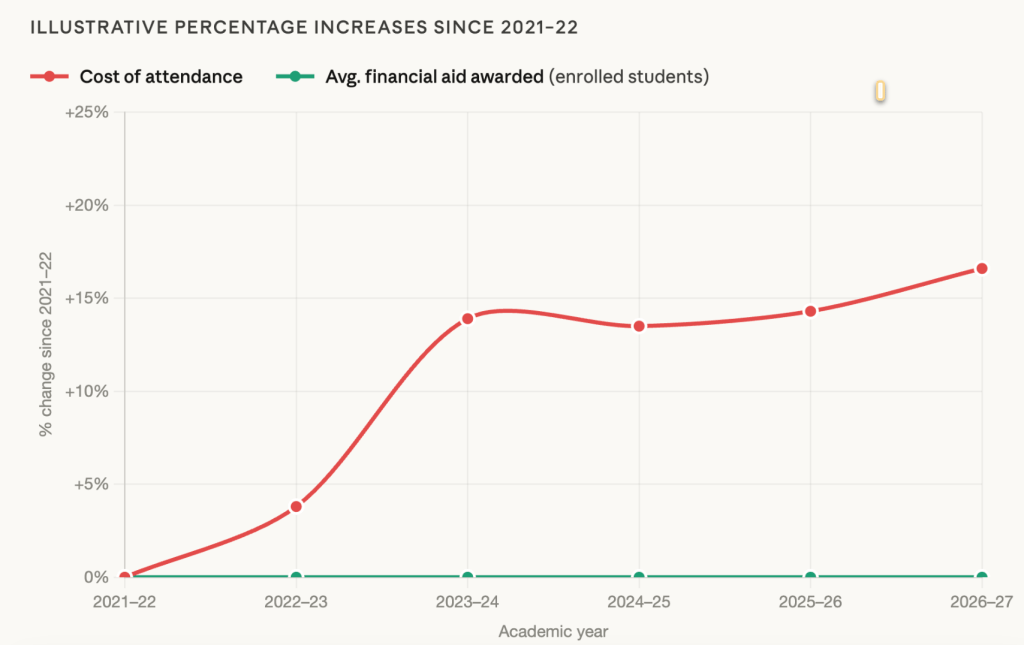
Rising expenses across higher education, ranging from utilities and maintenance to employee compensation and benefits, play a central role in shaping annual tuition and housing pricing decisions.
“For when we look at tuition and room and board increase, we’re looking first at how much the costs are going to increase due to the normal effects of inflation,” Rynbrandt said.
The effect inflation will have on employee salaries and benefits is also a top consideration. Rynbrandt said affordability is always front of mind for students, along with the understanding that Wheaton College’s goal — for students to have “the best Wheaton experience possible” — is a “significant investment.”
“We’re always cognizant of wanting to keep those increases as small as we can so that Wheaton can continue to be as affordable as we can make it,” he said.
Another key factor in setting tuition increases is Wheaton College’s standing among peer institutions. Rynbrandt said that Wheaton compares its costs to a cohort of approximately 37 similar schools. Compared with these other institutions, Wheaton College is often right at or around the median for year-over-year tuition increases.
Bella Turnbull, a Sophomore Biology major, has been affected by the tuition increases. Last year’s increase meant she could not afford to return to Wheaton for the fall 2025 semester.
“Finances were already tight going into this school year for a number of reasons,” she said. “But tuition raises did not help my case, so I just couldn’t come back last semester because of the financial cost.”
Now, she hopes that working as a resident assistant (RA) and working over the summer will keep her in school. However, Turnbull also noted that student employee pay was not being raised with inflation like tuition and housing costs were.
Starting on January 1, 2021, Illinois state legislature passed a gradual minimum wage increase, starting with $11.00 at implementation, and finishing at $15.00 on January 1, 2025. Student worker pay has since held at $15.00.
“Because your schedule only allows for so much time, I can only work so much every week when I’m taking full course loads so I can graduate on time,” she said.
When asked whether she feels Wheaton is doing enough to support students in her position, she shared that she feels both supported and disappointed. While she understands the economic need for tuition to be adjusted, increases have still contributed to her financial stress.
“I do recognize that financial aid services do a lot to support students,” Turnbull said.
Still, she emphasized that those efforts do not fully offset the burden for all students — particularly those trying to cover a significant portion of their own costs.
“I think that it’s hard on students, especially students who are putting themselves through school, to compensate for tuition increases,” she said.
Miles Schuiteman, a junior Bible and theology major, doesn’t feel that Wheaton has explained as much as it should about the tuition increases. He also wonders about the long-term effects of these increases on prospective students.
“It could definitely make it harder for future students to pay for Wheaton,” he said. “I wonder how many future students Wheaton will lose out on in the future, because if I were currently looking at applying for Wheaton, this would definitely factor in that decision.”
Many students wonder why Wheaton College has not used its endowment to help offset the effects of inflation. Last year, Anson Fleming, now an alumnus of Wheaton College, replied-all to the 2025-26 tuition announcement email to question the proposed changes.

Rynbrandt confirmed that federal laws restrict the college’s immediate use of endowment funds. The Uniform Prudent Management of Institutional Funds Act (UPMIFA) restricts the short-term use of Wheaton College’s endowment by legally requiring the school to honor donor intent. When donors specify that their gifts are to function as permanent endowments, Wheaton College cannot simply spend to meet immediate financial needs. Instead, UPMIFA requires institutions to manage and distribute funds “prudently,” balancing current support with the long-term preservation of the fund.
Recent and ongoing capital projects, such as the “Faithfully Forward” campaign which plans to renovate the library and athletic complexes, have prompted questions about whether construction costs are contributing to higher tuition. Rynbrandt was clear — capital projects have not contributed to higher tuition costs. Those building projects are constructed with “dollars from donors, not tuition,” he said.