
By Claire Taylor, Staff Writer
Wheaton College faculty and students conducting research in Meyer Science Center (MeySci) this summer faced a major setback after a power outage. The outage, caused by severe storms on the afternoon of July 3, lasted more than 20 hours, causing refrigerators and freezers containing decades’ worth of research samples to thaw.
The chemistry, engineering and biological and health sciences departments were affected by the outage. Across these departments, nearly a dozen faculty members lost research data.
While MeySci is equipped with a backup generator in case of power outages, the generator was damaged on May 18 due to another storm. Repairs to the generator were delayed due to an unavailable part, according to Jay Bieszke, chief facilities officer. When the part became available, the service provider was unavailable until August.
“The Meyer Science Center generator is now fully operational. The final repair was completed Sept. 9, and the generator subsequently passed a load test successfully,” Bieszke said.
Bryan McGraw, dean of natural and social sciences, was out of town during the outage. However, he recalls the unfortunate circumstances leading up to the outage.
“It was like this perfect storm of things that just happened all at the same time,” McGraw said. “If any one of them had not been a problem, then we probably would have been okay.”
At approximately 1:13 p.m. on July 3, the power went out across campus after ComEd, the company that supplies the college’s electricity, experienced an outage. Once the MeySci faculty realized the power was out and the generator was not on, they contacted Public Safety and facilities. In response, Wheaton’s battery energy storage system, supplied by solar panels in the parking lot of Billy Graham Hall and on the roofs of campus buildings, diverted power specifically to MeySci and Anderson Commons. The battery depleted after approximately eight hours.
After the battery ran out, Mary Vanderschoot, associate dean of natural sciences, along with other faculty, purchased generators from Home Depot to provide electricity to freezers containing research data.
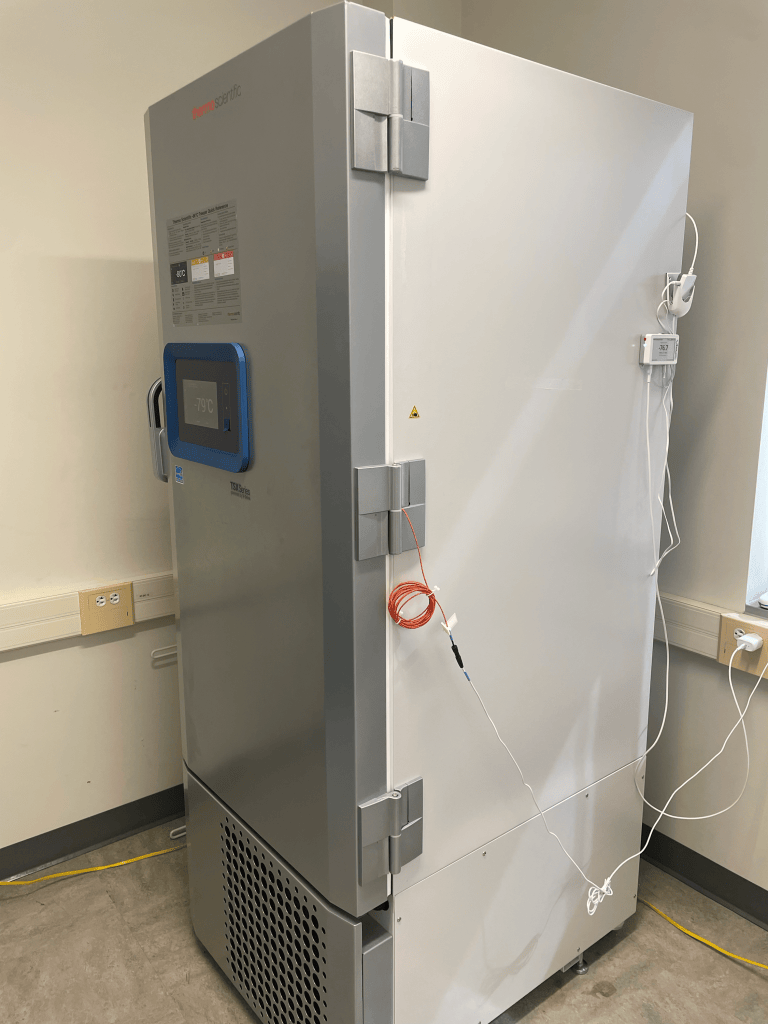
Research samples belonging to Corbin Renken, assistant professor of biological and health sciences, were able to be moved to one of the working freezers, and the majority of the samples survived.
Power was restored on the morning of July 4.
The repercussions of the outage included not only lost data, but also lost time spent checking data after it thawed and cataloging research that was lost.
When the outage occurred, student researchers working under Meredith Sommars, assistant professor of biological and health sciences, had two weeks left of the Summer Research Program. The majority of these last weeks were spent cataloging reagents, which measure rates of cell growth, as well as cell samples that had been lost in the outage.
One student researching under Sommars was Lela Plankeel, a senior health science major. By the time the power outage happened, she explained, the students had just started to get into a routine of research.
“All of our materials that we were using went down the drain, which is so sad because we were just getting momentum, and now we have to order everything over again,” Plankeel said.
Sommars was able to recover a small population of cells from the lost data, but everything else still has to be reordered. However, Sommars said, some data cannot simply be replaced.
“It’s the samples that are from my studies in graduate school or postdoc, or samples from here, that are harder to replace,” Sommars said. “And some of them are irreplaceable; there’s nothing I can do.”
Sommars, Renken and other faculty who lost research are now working on completing insurance claims that will be submitted to the Office of Risk Management. Then the work of replacing materials can begin.
“I have to decide if I should try to recover what’s lost or put my effort into something else,” Sommars said.
The power outage also led to a realization that communication between different offices on campus needed improvement. An emergency communication strategy is now being implemented, according to McGraw.
One improvement already made, Bieszke shared, is that facilities now has a single point of contact for MeySci.
“Facilities takes the reliability and resiliency of campus infrastructure very seriously,” Bieszke said. “We will continue to evaluate what we can learn from events like these and look for ways to strengthen our infrastructure, emergency-response capabilities and communication processes.”
