
By Jotham Bailey, Staff Writer
Wheaton’s Human Needs and Global Resources (HNGR) program celebrated its 50th anniversary on campus during a symposium from Sept. 17 to 19, an event HNGR office coordinators began planning nearly two years ago.
HNGR is a two-year academic certificate program at Wheaton College. Each HNGR student participates in a six-month internship with an international partner organization. Over the last 50 years, the office has sent out more than 1,000 interns.
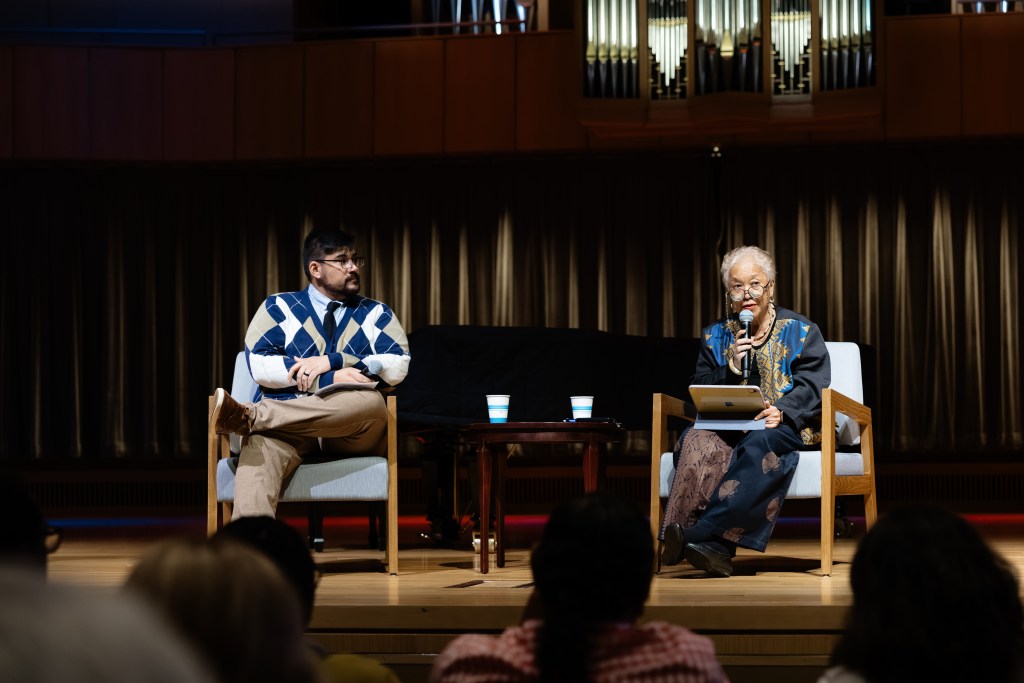
Melba Maggay, the headline speaker at the opening night of the symposium, is the founder and president of the Institute for Studies in Asian Church and Culture, and has hosted five of these interns, one of whom is currently with them. Maggay is also a social anthropologist, activist and award-winning author. She previously spoke at HNGR’s 40th anniversary celebration.
HNGR Director Laura Yoder mentioned that Maggay has been a role model for HNGR faculty personnel and interns alike, and was chosen for the plenary talk because she is a respected and active leader who represents what the program stands for.
“We could see her long life of faithful encouragement and learning, and she really embodies what we hoped the campus would see and experience: someone with a long life of faithfulness and learning, who is also fearless,” Yoder said.
Maggay was a leading figure among the Protestant Christians at the People’s Power Revolution in 1986, a series of nonviolent demonstrations in civil resistance which ended the authoritarian regime of Ferdinand Marcos, who had been a dictator over the Philippines for 20 years. One of the leading questions of the plenary talk was about what lessons the church should learn from her participation in the movement.
“I have several key lessons from that experience,” she said. “The first is the realization that we cannot have the resurrection, whether in society or in the work we do, without crucifixion.”
This quote from Maggay stood out to Jonathan Day, a sophomore international relations major applying for the HNGR program this fall.
“I really liked what she said about how members of the church — especially leaders — sometimes choose to preserve their institutions over actually following the gospel and what Jesus preaches,” he said.
Maggay was asked about a topic she has written about extensively: the practice of interpreting the Bible through the contextual cultural lenses of the people encountering the text. Jordan Ryan, associate professor of New Testament, who moderated the event, asked her about what she thought of the West’s tendency to consider gospel contextualization as syncretism, a heresy involving the blending of different beliefs into one.
Maggay claimed that Jesus’ incarnation tells us that the gospel has to come down from its ladder of abstraction for it to be told to the masses.
“Our context helps us see what we need to see in Scripture, and that is what the incarnation is about,” she said. “It’s important to put our own piece in the mosaic of what the gospel really means. It’s not syncretism — it is the Bible being read by the whole body of Christ.”

Haven Shedd, a sophomore anthropology major currently applying for the HNGR program, explained that she had a discussion about syncretism the very night before in her anthropology class, Culture and Difference.
“We were reading an article by a Native American Christian who gets called a heretic for trying to bring Native American culture into his practice of Christianity,” Shedd said. “It was cool hearing Dr. Maggay talk about the inherent multiculturalism of Christianity, and how it’s not actually something to be afraid of.”
One of the most impactful topics Maggay spoke on was God’s sovereignty. Multiple students remarked on being especially touched by what she had to say.
“The sovereignty of God is not an excuse for doing nothing,” Maggay said. “It is precisely because God is in control that I have confidence to fight and speak truth to power.”
Day felt especially impacted by Maggay’s encouraging message.
“In America, there’s a pretend division where you either follow the gospel and do spiritual things, or you’re an activist pursuing justice for people, but that’s not what the Bible says,” he said. “We’re not meant to live in two separate spheres, and I find it really encouraging when people much wiser and eloquent than me have put that together.”
Yoder also talked to students about their reactions to the event, and recalled how they, too, felt impacted by Maggay’s words.
“In almost all of her answers, she took a place where college students felt stuck, a conversation about two things often set against each other, and gave new eyes and a new perspective on the relationship rather than opposition between them,” Yoder said. “They appreciated that she helped them think about how God is sovereign, and how we are also called to act.”
Lilly Newell, a junior anthropology major, is part of the HNGR cohort beginning their internships next summer. She mentioned feeling moved by Maggay’s words.
“I felt so encouraged and refreshed and empowered,” Newell said, “I love the way she calls people out and speaks truth into things — nothing seems to faze her.”
Maggay ended the night with a call to action, reminding people to be persistent in their pursuit of Christ.
“We must wear out the powers. I always tell our people: outlast the enemy, outlast the opposition. Sooner or later they will get tired. But let us not grow weary in doing good,” she said.
