
By Julia Bubp, Staff Writer
New data from Wheaton’s institutional research office shows a slight decline in total enrollment over the past six academic years. According to the official dataset, total enrollment has dropped 1.55% between fall 2020 and fall 2026. Undergraduate enrollment declined 5.39%, while graduate enrollment has increased by 11.98% over the same period.

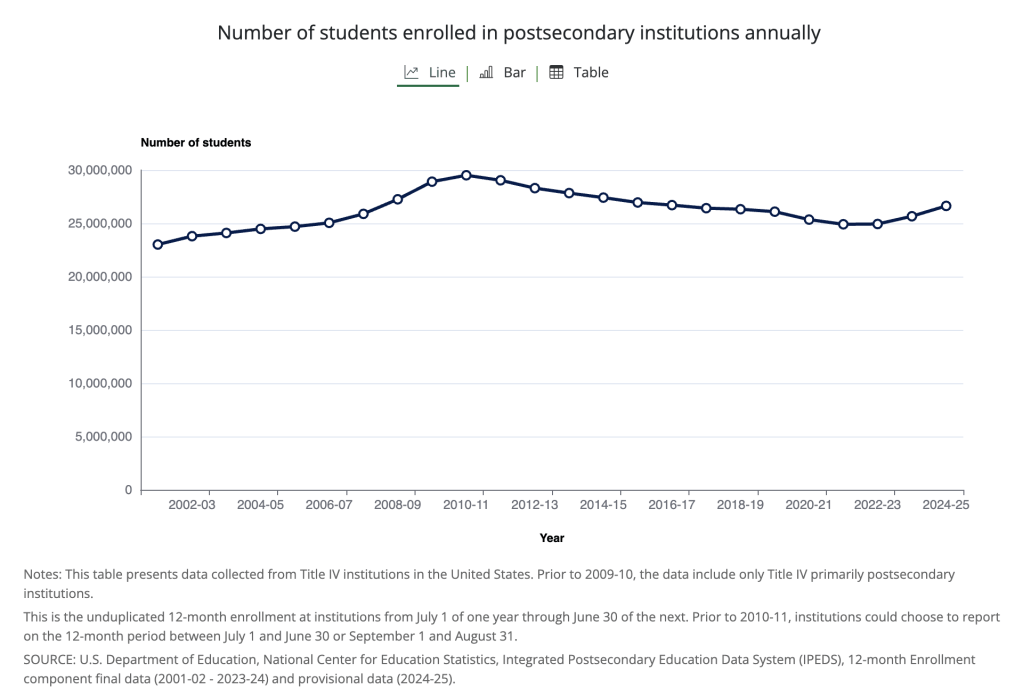
U.S. college enrollment declined from its 2010 peak of 29.51 million students to 26.63 million in 2025, according to the National Center for Education Statistics’ Integrated Postsecondary Education Data System. Silvio Vazquez, Wheaton’s chief enrollment management officer, oversees the enrollment division, which works with students from recruitment through admission. In an email to The Record, Vazquez wrote that Wheaton’s 2026 incoming class fell short of the 600 to 630 student goal.
“We landed with 579, which was below our target,” he said. “Unfortunately, this will have a negative impact on our budget next year and for the following three years.”
Vazquez said institutions nationwide are facing uncertainty because of the demographic cliff, a decreased college applicant pool caused by declining birth rates following the 2008 recession. In addition, he noted that students and families are increasingly questioning the value of higher education, and institutions must provide students with evidence that their degree is worth its cost.
“Higher education is facing a national crisis of confidence around value, cost and return on investment,” said Vazquez. “Families are asking more direct questions than ever before: Will this degree prepare my student well?”
Many of Wheaton’s peer schools are feeling pressure from changing demographics. Nationwide, 16 nonprofit institutions announced closures in 2025, including Trinity Christian College in nearby Palos Heights, Ill. However, several Midwestern Christian colleges have seen significant recent growth. Indiana’s Taylor University welcomed its largest incoming class in school history this August and has begun construction of a new chapel and welcome center. Cedarville University in Ohio announced plans to open a second campus in Clearwater, Fla., in January 2027.
Vazquez said highlighting the uniqueness of a Wheaton education is important when reaching prospective students. As students focus on affordability and career readiness, Vazquez said that Wheaton’s enrollment strategy underscores both.
“In a crowded marketplace, many institutions can begin to sound the same,” he said. “Wheaton’s ability to combine strong postgraduate outcomes with deep Christian formation is an important part of our distinctiveness.”
Amid the uncertain enrollment landscape, Wheaton has focused marketing efforts on its Christ-centered identity. For first-year undeclared psychology major Taline Labib, Wheaton’s integration of faith and learning was a major factor in her college decision. Labib was admitted to Northwestern University but ultimately chose Wheaton because of professors’ commitment to faith in the classroom.
“I wanted to study psychology, and I wanted to do it from a Christian perspective,” she said. “I wanted to have an education where it’s not just all about the information that’s being transferred into our brains, but it’s about who we’re actually becoming.”
Vazquez also emphasized the value of Wheaton’s precollege programs, including the Wheaton College Summer Institute (WCSI) and BRIDGE, in bringing in undergraduates. Elia Young, a first-year undeclared English major, participated in WCSI in 2024. She said that the program was a key reason she chose to attend Wheaton.
“That was a really great experience to get a sense of college life,” said Young. “It was my first time being away from home for that long, and I think it really helped me get used to it, as well as the academic rigor.”
Adonia Mattson, a sophomore biblical and theological studies major, works for the Wheaton admissions office through the Diakonoi program. As part of her role, she gives campus tours and hosts prospective students, emphasizing the range of what Wheaton has to offer.
“You’ll see liberal arts schools, you’ll see Christian schools, you’ll see schools that have programs like the Aequitas Fellows, but Wheaton has all of those programs, along with really successful athletics,” said Mattson. “It’s such a unique place.”
Wheaton is leaning into these differentiators while navigating changes in enrollment, and Vazquez said that his team remains committed to institutional identity. He added that he is grateful for the students who have chosen to spend their college years at Wheaton.
“Ultimately, the goal is not simply to enroll a certain number of students,” said Vazquez. “The goal is to enroll students who will thrive here — students who are academically prepared, committed to Christ, eager to contribute to this community and ready to be formed for Kingdom service in whatever calling God has placed on them.”
