By Julia Bubp, Staff Writer
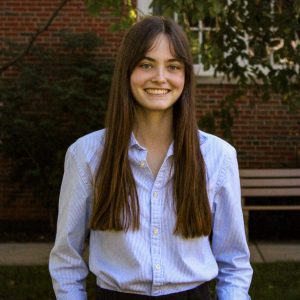
When Julia Humphries arrived on Wheaton’s campus as a freshman in 2025, she was one of 54 Catholic students surrounded by more than 2,000 Protestants. Now a sophomore psychology major and the co-president of Wheaton’s Aquinas Catholic Fellowship, Humphries hopes to bring students of all faith traditions into a centuries-old conversation.
Wheaton’s Roman Catholic student population has grown 55% in the past four years, from 40 students in fall 2022 to 62 in fall 2026. Catholic students make up 2.17% of Wheaton’s total enrollment in 2026, up from 1.39% in 2022. Humphries said she found it difficult to meet other Catholic students during her freshman year, and she knew early on that she wanted to start a Catholic club.
“I realized that there were a good amount of Catholics, and we were all scattered,” said Humphries. “I felt like it would be nice to have a good community, and the more Catholics that I met on campus, the more I realized that they wanted this, too.”
Catholicism and Protestantism are two branches of Christianity. During the 16th century, a group of reformers within the church split off due to what they saw as irreconcilable theological disagreements on topics including the authority of church tradition and salvation through faith or works, creating the Protestant church. Today, Catholicism emphasizes liturgy and the sacraments, while Protestantism focuses on preaching and congregational singing.
John Shank, a junior biochemistry major and vice president of the Catholic Fellowship, converted to Catholicism after enrolling at Wheaton. With a Reformed background prior to his conversion, Shank said he’s seen increased interest in high church services, including Catholicism and Eastern Orthodoxy, among Protestant students.
“I think it satisfies what a lot of people are looking for when they come from a low church background,” Shank said. “That was my experience.”
Humphries wasn’t raised Catholic either, and she converted to Catholicism during her senior year of high school. She said that she became a Christian in middle school and initially attended a nondenominational church, before learning more about Catholic sacraments and practice and eventually converting.
“The more I looked into Catholicism and learned about the Eucharist,” said Humphries, “I fell in love with it and fell in love with the reverence and silence.”
Julia Butkus, a junior elementary education major, is co-president of the Catholic Fellowship with Humphries. Butkus was raised in a Catholic home and attended Catholic elementary and middle schools. She said she appreciated Wheaton’s commitment to faith and initially hesitated to start a Catholic club, not wanting to emphasize divisions between traditions.
“I was so happy to be in a school that was unified under Christianity,” Butkus said. “I can form community with Protestants, but I realized I also wanted to talk about the niche Catholic experiences that I can’t talk about with Protestants.”
Humphries and Butkus formed a student cabinet and officially chartered the Aquinas Catholic Fellowship in May 2026. Humphries asked William Struthers, a professor of psychology, to serve as the club’s faculty adviser. Struthers was Humphries’ professor for CORE 101, a seminar centered on core texts required for all first-year Wheaton students.
“In the CORE 101 class, I’ve always tried to be very respectful and mindful about Roman Catholic teaching,” Struthers said. “I’ve tried to always be clear that I’m less about hammering Protestant theological truths and more about having an honest and mature conversation about differences between traditions.”
Struthers said he personally holds Protestant faith commitments but has devoted time to understanding different branches of Christianity. All Wheaton faculty and staff are required to sign a statement of faith annually, which explicitly aligns the college with the Protestant tradition. In 2004, then-President Duane Litfin dismissed philosophy professor Joshua Hochschild after he converted to Catholicism.
According to Wheaton’s website, “The statement accordingly reaffirms salient features of the historic Christian creeds, thereby identifying the College not only with the Scriptures but also with the reformers and the evangelical movement of recent years.”
Humphries said that while she was surprised to learn that Wheaton does not hire Catholic faculty and staff, she still wanted to enroll. Despite being part of one of the smaller faith communities on campus, she said she has felt respected by her professors.
“Sometimes I find it sad not to have faculty that represent me as a Catholic,” said Humphries, “but it has made me feel better to know that even though they might not have the same exact beliefs as me, they’re here to support.”
Struthers emphasized respect and open dialogue between Catholic and Protestant students, particularly around core texts like Augustine’s “Confessions,” which is taught in all first-year seminars. He said he hopes his Catholic students will be able to share their perspectives and grow in their faith through conversations in class.
“I am pleased that the college is open and invites students with Catholic faith commitments to come,” said Struthers. “I think the Roman Catholic students bring an incredible tradition to our student body that we would be wise to pay attention to and appreciate.”
After officially chartering last spring, the Catholic Fellowship is beginning its first full semester and preparing to host events open to all students. The club has partnered with the young adult ministry at St. Michael Catholic Church, which Butkus, Humphries and Shank all attend. Humphries said that her goal is to encourage charitable conversations about Catholicism as she sees more Catholic students coming to campus.
“I always recommend going in with an open mind and letting conversations happen because they can be very fruitful,” Humphries said. “You might be surprised.”