
On Friday morning, President Philip Ryken called students to delete or avoid joining Fizz, a social media app popular on college campuses that launched at Wheaton the previous day, Jan. 18.
In an unusual start to chapel, Ryken stood at the front of the auditorium and called the student body to a “family meeting.” He told students that he knew Fizz was circulating campus and voiced his concerns about the effects of the app.
His request?
Delete Fizz by noon, and stay off of it.
“I just know from my understanding of the human heart, from my long experience on this campus, we are not godly enough to handle anonymous communication,” Ryken said.

Fizz, now owned by a Palo Alto tech founder, was originally created by two students at Stanford University in the fall of 2020. Its team, composed mostly of college students from around the country, now operates Fizz at over 80 colleges. Fizz users must sign in with a school email address, but the app’s creators say it is unaffiliated from any institution and that no school will ever have access to user activity. Users can submit posts in various categories, including “Event,” “Poll,” “DM me,” “PSA,” and “Meme.” Other users can up-vote a post to endorse it, curating a feed of the most popular posts, similar to apps like Reddit. Fizz was banned at some Florida colleges in April.
Fizz recruits local student moderators and ambassadors for each campus, usually through LinkedIn, to create a centralized platform specific to each campus community. While ambassadors spread the word about Fizz around the school, moderators have the ability to remove posts that don’t align with Fizz’s Community Guidelines, and are awarded higher scores called “Karma” for their posts. But no single moderator can remove a post without the corroboration of a second moderator, and they cannot see users’ email addresses or identities, including each others’.
Anonymous platforms of student expression online have grown in popularity at Wheaton since spring 2020, after the disbanding of the Forum Wall, a bulletin board in Lower Beamer to which anyone could anonymously stick paper-and-pen opinions, memes or flyers for public view. Unaffiliated Instagram accounts intending to replicate the platform online, like @forumwallwheaton, launched in April 2021, and @forumwallwheaton2.0, launched in January 2022, have over a thousand followers each.
Ryken told the Record that his call to action was aimed to encourage students to help the community honor God and love one another, rather than about anything the college is planning to do. He said he had not personally reviewed any content from Fizz, but that various students had informed him of content they had seen that “did not honor God, express love for others, or build up our community with what is good, true, and beautiful.”
Although Ryken said the college was not planning enforcement measures, Paul Chelsen, vice president of Student Development, told the Record that students’ posts on Fizz could have consequences, just as they would on other social media platforms.
“What students say could trigger a variety of potential policy violations,” Chelsen said. “Examples include harassment, discrimination, bias, bullying and the Alcohol & Drug-Free Community Policy.”
Already, posts on Fizz include violations of the college alcohol policy.
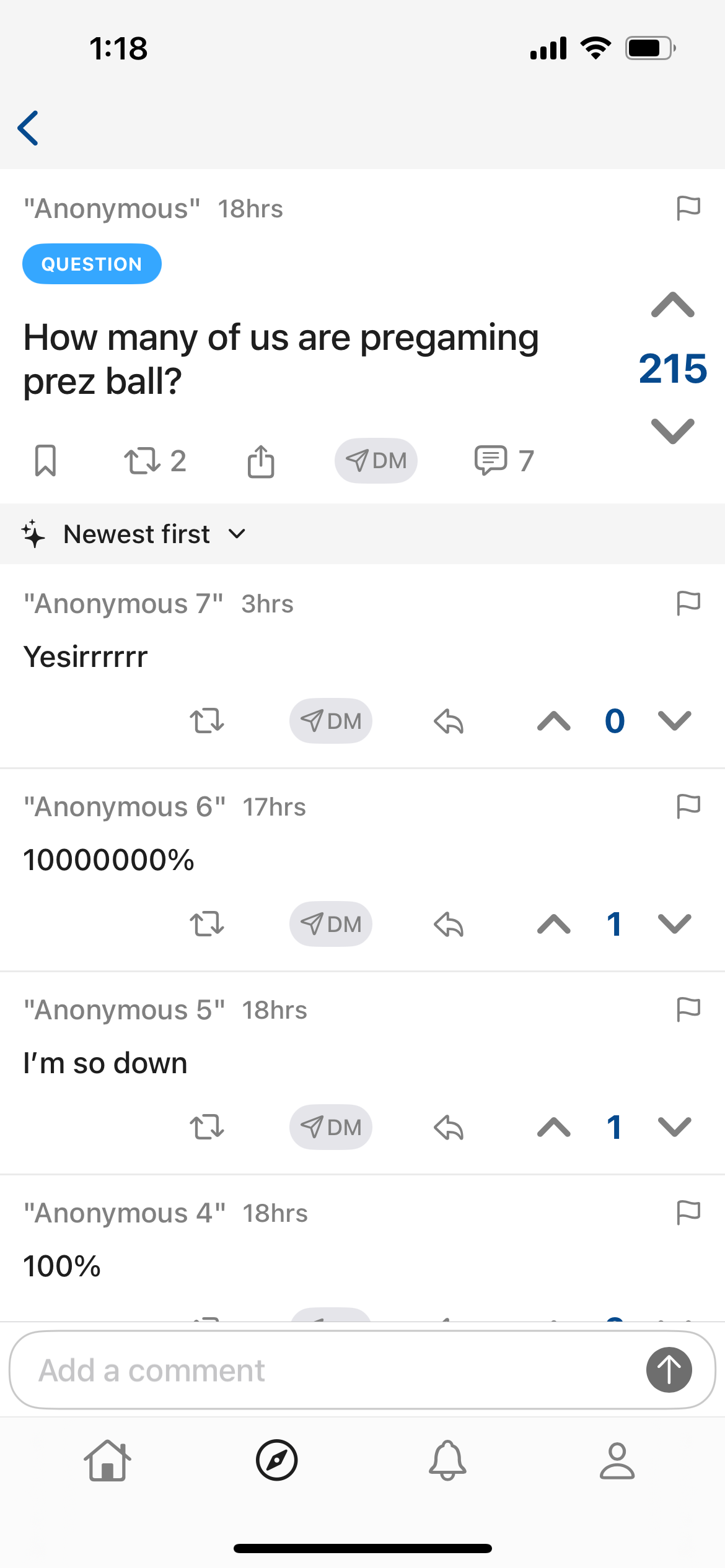
“How many of us are pregaming prez ball?” one user asked the public soon after the app’s launch, referring to College Union’s annual formal dance, scheduled for February 19. The post had 215 up-votes.
“I’m so down,” replied another.
Some students were skeptical of Fizz since first hearing about it. Susanna Snavely, a freshman, said she never downloaded Fizz, and thought the need to log in with Wheaton credentials made it obvious that it wouldn’t be truly anonymous.
“All I saw were screenshots and it looked kind of weird, and for the most part, destructive,” said Snavely.
Nathan Belsley, a junior biblical and theological studies major, said he originally got on Fizz because he found the idea of anonymous messages interesting. But like Snavely, he now believes the anonymity makes Fizz a problem.
“I spent a lot of time looking at the app to see what many people actually think about Wheaton,” said Belsley. “But like Ryken said, we’re sinful people. Anonymity, and a lack of accountability, doesn’t do the human heart any favors.”
The Fizz launch comes exactly a year after a different unaffiliated Instagram account, @barstoolwheatonil, posted an offensive meme of a Wheaton student whose image had been filtered to appear in blackface. In an email to the campus on Jan. 17, 2023, two days after the meme was posted, Ryken repudiated the meme and said administrators had contacted the account to get it taken down. He acknowledged then that this was not the first time in recent years that an anonymous, racially offensive post had shaken the community.
A similar incident brought down the original Lower Beamer Forum Wall. An unsigned meme mocking the first standalone chapel service hosted by Unidad Cristiana, the Hispanic and Latino student union, was tacked on the wall in September 2019. Student Government attempted to crack down on anonymous postings in the spring, but faced peer backlash for doing so.
Fizz’s settings prohibit a user from deleting their account within 24 hours of creating it, so users who created an account anytime after noon on Thursday were not able to abide by Ryken’s appeal.
Following Ryken’s message, students took to Fizz to voice their own replies.
“Fizz is out here just exposing the issues with the school,” reads one post, submitted around the end of chapel. “And prez has a solution to the problems: Just get off Fizz and keep pretending that the school doesn’t have issues.”
Noelle Worley, Kara Grace Hess and Bella McDonald contributed reporting.
