Back in the early 2000s, a film crew from PBS visited Wheaton’s campus to document a discussion on science and faith – part of a series on the theory of evolution. The topic that night was the Book of Genesis and how Wheaton College students viewed the Bible’s creation account with what they were learning in science class.
More than two decades later, that PBS series and the topic of faith and evolution was again up for discussion as part of a six-week series on a “How to Read the Bible” series sponsored by the chaplain’s office and meeting on Wednesday nights.
On Feb. 28, Les Barker, a web content management specialist for the Wheaton College marketing and communication department, hosted a discussion about the relationship between faith and science as part of the six-week “How Not to Read the Bible” series. The series, which began on Feb. 7, is sponsored by the Chaplain’s Office and meets on Wednesday evenings. Discussion topics have ranged from evolution to women in the Bible, tattoos and universalism.
The event, which was the fourth installment of the series, was held in the Chicago Room in Lower Beamer. The hour-and-a-half session covered ancient cosmology; the 2001 PBS documentary, “Evolution,” which featured Wheaton students and faculty; and the overarching question, “Does our faith force us to choose between science and the Scriptures?”
Barker started the discussion by emphasizing the importance of asking questions about how to read the Bible.
“We need to ponder how Genesis was understood by the first people who read or heard about it,” he said. “Is it simply a description of the physical world’s creation? Or is it more? How can we know?”
John Walton, professor of Old Testament emeritus at the college, regularly broached these questions in his Wheaton classes. His book, “The Lost World of Genesis One,” proposes and defends the claim that we should not interpret Genesis 1 as an account of material origin, which is a view often espoused by creationists. Rather, Walton says it is an account of God giving functions to the created world.
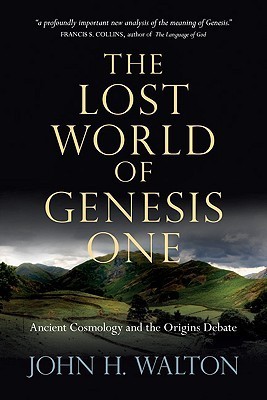
Walton was not present at the event but his arguments were well-represented. Barker explained that Genesis was written to the people of Israel 3,500 years ago, and it incorporated imagery and symbolism used in many other creation narratives at the time.
To end the event, Barker provided external resources to facilitate further discussions about faith and science and the topic of origins from a biblical perspective. He also passed out several free copies of Walton’s book.
At Christian institutions of higher education, there is longstanding controversy surrounding the debate between creationism and theistic evolutionism. Young Earth creationism refers generally to the belief that God created the Earth in six 24-hour days, and that the Earth is anywhere from 6,000 to 10,000 years old. Theistic evolutionism is the belief that the origins of the universe can be attributed to evolution, but it was set in motion by God. Theistic evolutionists generally believe that the Earth is 4.5 billion years old, which is the age agreed upon by a majority of scientists.
On Feb. 5, Cedarville University announced on Facebook that it had partnered with Answers in Genesis, a fundamentalist Christian apologetics organization advocating for young Earth creationism, and received an official designation as a Creation College. In 2019, Bryan O’Neal, then-vice president and dean of Moody Bible Institute, said that the college rejected “evolutionary processes between kinds” and adhered to the doctrine of Adam and Eve’s special creation.
Other Christian institutions, like Notre Dame and Baylor University, teach evolutionary science in their natural sciences programs. Baylor’s website includes a statement of evolution, which states that the university teaches evolution because it is accepted by the majority of scientists and is fundamental to the understanding of modern biology.
At Wheaton College, faculty must sign a statement of faith which includes the belief that God directly created Adam and Eve, and that they are the historical parents of the entire human race. Classes like Earth and Dynamic Environment, expose students to five differing views of the origins of the Earth: atheistic evolution, deistic evolution, theistic evolution, old Earth creationism and young Earth creationism.
Walton said he believes this is an important topic for the college to approach.
“Students might come out of high school with the idea that things are all black-and-white. One of the duties of a good college education is to help indicate that we don’t live in an entirely black-and-white world,” he said in an interview with the Record. “Our job is not to tell students what to believe. We are giving students a way to understand integration and compatibility in ways they may not have experienced before.”
Read Schuchardt, associate professor of communication and faculty advisor of the student-led Creation Society, said he interprets Genesis differently from Walton, but he also believes this is an essential topic of discussion.
“This debate often gets shunted as a side issue,” he said. “I hear people say that it’s not important because it’s not essential to salvation. In my view, you can’t separate the two.”
Robert Bishop, professor of physics and philosophy at the college, said he believes there should not be pressure on students to adopt an absolutist belief.
“Students do not necessarily have to come to a final decision on creationism and evolution,” he said. “It can be a continually working conversation, and students can see where it is that God leads them through that.”
Bishop and Walton said they have observed from their teaching experiences that the evolutionism/creationism conversation has become less tense in recent years. Bishop said he is hopeful that students will remain curious and open-minded about the topic.
“Nowadays, students come into my classes with questions about what to think about these things, and more of them are expressing that they don’t know exactly what they believe,” he said. “They know what their parents and church have told them, but they are curious. They are wondering.”