On President’s Day morning, Feb. 21, with temperatures near zero and a strong wind chill, eight Wheaton College students drove to Chicago’s River North neighborhood to conduct a demonstration in front of the Trump Tower.

The group went to raise awareness and advocate, but their primary goal was to start conversations about a Christian response to recent changes in federal policy, like the end of aid for relief projects, refugee resettlement efforts and a holistically pro-life agenda.
While many students were preparing for the annual winter dance that evening, these eight students prayed for their nation, sang hymns, shared devotionals and conversed with passers-by.
“It was encouraging to see that there were other students bothered enough by suffering to do something about it,” said Ariela Dawson, a sophomore majoring in studio art. “I was reminded of God’s power in the midst of situations that feel too daunting to fix, and I’m excited to see how he uses the little that we are able to offer.”
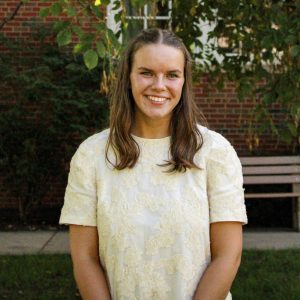
A first-year student majoring in anthropology and urban studies was the primary architect of the event. In the wake of Wheaton’s X post about Russell Vought’s appointment, Jonathan Porteous wrestled with how Wheaton students could engage the national news and the way it is playing out on Wheaton’s campus. Porteous noted a hesitancy among students to engage with others on controversial issues during his first semester.
“Not because we’re scared in general,” he says, “but we’re maybe afraid of offending people, not knowing enough or finding out a friend disagrees with us.”
He planned this demonstration to invite dialogue about what faithful Christian living looks like in unusual times, both on campus and on the streets of Chicago.

“What’s beautiful about a community of people who are trying to follow Christ and at the same time trying to promote certain issues is that everybody is going to come at it from a slightly different angle,” Porteous said. “The interactions that individuals have with other individuals are going to be different.”
Timothy Ritterbusch, a first-year political science major, shared that he, like many current students, has struggled to know how to react to events that have followed Jan. 20, 2025, in a way that “makes a positive difference.”
He was thankful for the opportunity to share his views with others that chilly Monday morning, and said, “It was good to take a tangible step in advocating for global public health, rather than simply complaining about policies I object to,” he said.
Each participant interviewed was excited by the prospect of planning more outreaches and advocacy opportunities in the future.
“We have a lot more agency to address problems than we think we do,” Dawson said. For her, the average Wheaton student’s privilege of being educated in an affluent country with the resources and flexibility to advocate for others is an opportunity that cannot be squandered.
“We are far from powerless. If we are genuinely determined to address injustice, we can have a bigger impact than we realize,” she said. “We must remember that biblical messages about advocating for the oppressed are not just suggestions, they’re commands.”