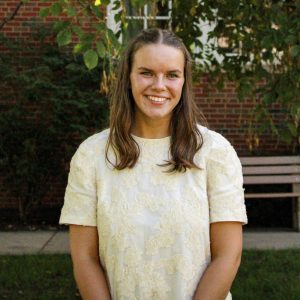
Outside of the biological and health science department, most students are unaware of what goes on in the Wheaton morgue and cadaver labs. But Dana Townsend, professor of applied health science, spends hours every week teaching students human anatomy, making sure to maintain respect for the cadavers as students perform dissections. After 13 years teaching at Wheaton, Townsend is retiring at the end of the 2024-2025 school year.
When she was first offered a job at Wheaton College, she had no clue what the college was. She knew the chair of Wheaton’s applied health science department from Kansas State University, where she was teaching at the time, but when he called her up to invite her to work at Wheaton, she had never heard of the school.
She was hesitant to consider the job. As a new Christian, she had come to see working at a large secular university as a unique missional opportunity and was unwilling to give it up. “I’ve got the undivided attention of people that really are not people of faith,” she recalls thinking at the time. “Why would I come to a small Christian school? Where would the ministry be in that?”
But as she talked with her family and friends, Townsend felt like she was being pushed toward Wheaton. After completing the interview process, she grew more optimistic about uprooting her life to move to Illinois.
At the time, she thought she was coming to Wheaton because the school needed someone to teach anatomy and physiology. But she quickly realized she had left her secular state university for her personal growth. “The first time I prayed with my colleagues in the hallway, I just wept. I had never experienced anything like that,” she said.
Raymond Lewis, professor of biology, recalls first meeting Townsend and her husband at church the summer she moved here. He said that while they were trying to move in, a storm came through and tore out all sorts of trees, resulting in a power outage.

Townsend had been teaching anatomy for several years at that point, though she spent the first part of her career in ecology, Lewis’s specialty. Though their departments were separate at the time, Lewis and Townsend found time to discuss the various plants they had worked with, which Lewis said he very much appreciated.
Although she has now taught at Wheaton for over a decade, she finds herself learning new things each year, such as deepening her understanding of what it means to be gracious. “My students are just something — how young they are, how much maturity they have, and I have learned a lot about being a Christian and got to be immersed around people that live that out in their words and their deeds,” she said.
As much as Townsend has been impacted by her students, they have been equally, if not more, inspired by her care for them. Junior health science major Elizabeth Huiskes said Townsend loves singing hymns to begin class, and her use of stories helps students remember the lecture material.
“She would always tell stories about something related to the lecture we were talking about,” said Huiskes. “I remember the story so well, and because she’s such a good storyteller, it ingrained in my head what the concept was about, or how this super nitty gritty anatomy detail applies to the real world.”
Townsend thinks that the chance to dissect cadavers, a rare opportunity for undergraduate students, is the best way to learn anatomy. “I’ve seen the wonder that they find out about when they see the differences between people, God made this heart backward, things you just don’t learn from a model,” she said.
Townsend pays great attention to respecting the cadavers, noting that each person who donated their body to the college gives the students a gift, and holding a memorial service for the cadavers every spring. “It isn’t just an avenue to get a grade or to do well in school; they get the gift they were given, and we try to keep that reverence,” she said.
Lewis said it will be hard for the next anatomy professor to bring Townsend’s level of respect for the cadavers. “I think it’ll take some time for the replacement to bring out the spiritual side of what she does, of human bodies that hold the person. How sacred that is, the respect that she shows the engagement with Christ himself being incarnate,” he said.
Townsend is no stranger to illness and death in her personal life. Four years ago, Townsend’s mother, who had cervical cancer, came to live with her. She was not a Christian — a point of tension between the pair — but Townsend felt that their relationship developed into a friendship because they spent more time together.
“We got to talk about everything, including my faith. It wasn’t awkward at all,” said Townsend. “She said to me, ‘Dana, you’ve become my friend.’ I said, mama, you’ve become my friend.’”
When they heard Townsend’s mother was sick, her teaching assistants got together to write her mother notes of encouragement. “I read it to her and my mother, for the first time, wept. She said to me, ‘Dana, do you know how unusual this is?’” said Townsend. “And I said, ‘Well, they love you and they love me. They want you to be at peace with God.’”
Townsend took a week off to visit her mother in hospice this past winter and said that in her last moments with her, her mother uttered the word “Christ” twice, which would be her last words. “I said, one last time, ‘Mom, Christ is Jesus. Jesus is a son of God. He’s the one who will assure you into God’s kingdom to be with him. He is your salvation,’” said Townsend. Townsend said her mother seemed very at peace before she passed the next day.
Townsend, who feared her mother would never come to know Christ, credits that moment to the Wheaton community. “It took a whole college, and it took all my teaching assistants (TAs) to woo her to Jesus. It wasn’t just me,” she said.
Many of Townsend’s students were touched by the story of her mother’s last words. “It was such a powerful story when Dr. T. was telling us about what happened the day of her mom’s death,” said Huiskes. “It was all the Lord’s work for sure.”
The closeness of the Wheaton community has made it hard for Townsend to retire, and she is praying for discernment over what her vocation will look like, particularly as she has spent the last several decades surrounded by young adults.
“I am looking forward to God answering that prayer. I need to have a purpose that is useful for somebody else,” she said, noting that she hopes to build more relationships with people her age as she enters retirement.
Huiskes said she will miss Townsend’s mentorship as a strong woman knowledgeable about anatomy. “I always found I could go to her with questions, and she would elaborate more, and that was inspirational as a little sophomore, and even as a junior who doesn’t really know that much and wants to learn more and found anatomy fascinating,” she said.
Over her 13 years at Wheaton, Townsend continues to find herself impacted by her students’ faith and gratefulness for her teaching. “The students have affected me so much. I’ve gotten to spend 13 years now growing up,” she said. “I can’t tell you how important that is to me.”