By Orli Strickman, Senior Managing Editor
On Friday, Sept. 25, several hundred people gathered in Edman Chapel for an event titled “Reconciling Narratives: Islam, Israel, the West and the Gospel.”
The event featured speakers Darrell Bock, a Wheaton trustee and senior research professor of New Testament at Dallas Theological Seminary, and Ayaan Hirsi Ali, a New York Times best-selling author of “Infidel” and an advocate for religious freedom and human rights.
Faculty, staff and students were notified via email from Bob Norris on Sept. 22 of the plan for increased Public Safety and law enforcement presence by Edman because of the event.
“We are sharing this information so the increased security presence does not cause unnecessary concern,” the email read.

Hirsi Ali was born in Somalia and brought up in a strict Muslim family. Her family lived in exile and eventually settled in Kenya because her father was a critic of the Somali dictatorship. Hirsi Ali has received death threats because of her criticism of Islam.
Attendees were required to pass through a metal detector, and no bags were allowed. Guests were told to arrive by 6:30 p.m. The event was scheduled to begin at 7 but started at 7:24 because of the hundreds of people still in line. The line snaked outside of Edman past the Wheaton College library.
Dyanne Martin, associate professor of English and Core Studies, began with an introduction. She said the event was sponsored by the Core Studies department, Wheaton alumni and the Redwood Coalition. She also provided a disclaimer that the views expressed by the speakers are not necessarily endorsed by the college.
Martin encouraged the audience to remain courteous to the speakers.
“A liberal arts education is the free inquiry and exchange of ideas, drawing from different fields to become a whole person,” she said. “I love that Wheaton provides that kind of space to engage in free inquiry.”
Dan Haase, chair of the Christian Formation and Ministry Department, prayed and read aloud Romans 12:12: “Rejoice in hope, be patient in tribulation, be constant in prayer.”
Martin then introduced Bock, who had 20 minutes to speak. Bock began by acknowledging the tension surrounding the event.
“There are few discussions more controversial than the conflict in the Middle East,” he said.
He emphasized that, in his view, the inclusion of Gentiles in the kingdom of heaven does not indicate Israelite exclusion. “That others will come to participate in this does not mean that Israel will be excluded,” he said.
Martin then introduced Hirsi Ali, who also had 20 minutes to speak.
Hirsi Ali began with an anecdote about attending an Islamic school at 15. Her best friend growing up was not a Muslim, and she recalled being told to convert her.
“I learned not to take Jews or Christians as friends or allies — they were friends with one another,” Hirsi Ali said.
Hirsi Ali said that her understanding of Muslim doctrine growing up emphasized clear divisions between Muslims and Jews, in particular. “I learned that Jews had a special place in hell,” she said. “We would plead with God to destroy them all — man, woman and child.”
Hirsi Ali noted the difference between da’wah and jihad, and the importance of such a distinction after the Sept. 11, 2001, terrorist attacks. She said that understanding Muslim doctrine is crucial to understanding the current conflict in the Middle East, including the Oct. 7 Hamas attacks.
“I understood what happened in October 2023 not as a territorial dispute, as the media tells it, but as doctrine,” she said.
A recent convert to Christianity who was baptized two years ago, Hirsi Ali cited Matthew 28 and said Muslims are hungry for the message of the gospel. “To my delight, I have seen many Muslims come to Christ,” she said. In response, the audience broke into applause.
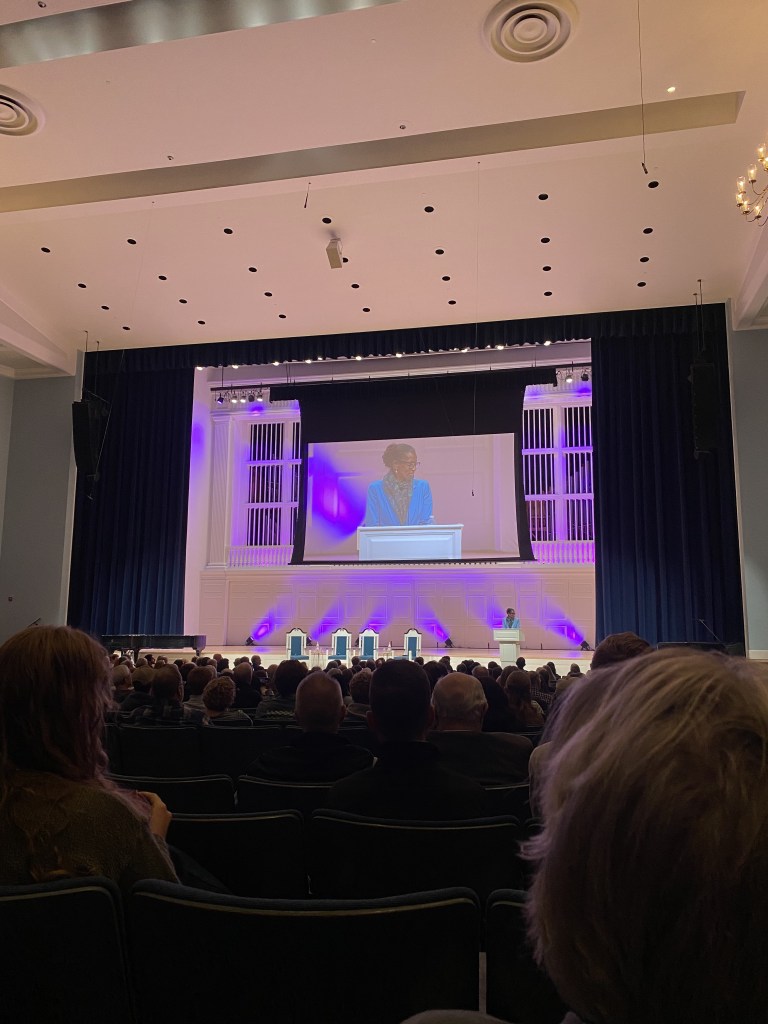
Bock and Hirsi Ali then participated in a 40-minute question-and-answer session. Audience questions were submitted anonymously on Slido, and then read by Martin and Haase.
One audience member asked whether Hirsi Ali sees parallels between jihadist Islamic groups and Christian nationalists in America.
“I was always struck by the contrast that I have had to have a number of armed men with me at all times because I left Islam,” Hirsi Ali responded. “Do I see parallels? No, I do not.”
In response to questions about the current war between Israel and Palestine and how Christians should respond, Hirsi Ali argued Israel and its enemies have completely different concepts of human life. She said some Muslim doctrines place women and children in harm’s way for the sake of martyrdom.
“The pathway to peace is to convert everyone, and that is the mandate,” she said. She also questioned why other Middle Eastern countries refused to take refugees from Palestine.
Ruben Loeffler, a Wheaton graduate student in TESOL and intercultural studies, said he left the event concerned that moderators did not leave room for critical opinions and questions.
“Avoiding them leaves me and, from what I noticed after the event, other students under the impression that these questions were either too uncomfortable or didn’t fit the spirit of the event,” he said. “The title ‘Reconciling Narratives’ wasn’t satisfied, in my opinion.”